I was never very interested in genealogy in past years. The family I knew were enough, sometimes more than enough.
My initial foray into genealogy was with the sceptical outlook of a philosopher of science tasked with preparing a conference talk for the biennial meeting of the International Society for the History, Philosophy and Social Studies of Biology, held at University of Exeter in 2007. I was part of a panel on molecular anthropology, joined by historian Marianne Sommer and geographer Catherine Nash, both of whom I quite admire for their outstanding contributions as scholars.
My talk was titled “From Flies to Humans: The Genetic Basis of Group Identity.” I described the sorts of DNA ancestry tests that were available and gave examples of claims made in companies’ marketing materials about how DNA ancestry tests lead to discoveries about our identity, about who we really are. I examined the scientific foundations based in population genetics for claims about group identity and pointed out the wrongheadedness of assumptions about populations being discrete, homogeneous, and hierarchically structured, as well as the contingency of choices — and their socio-historical situatedness — implicated in bounding populations.
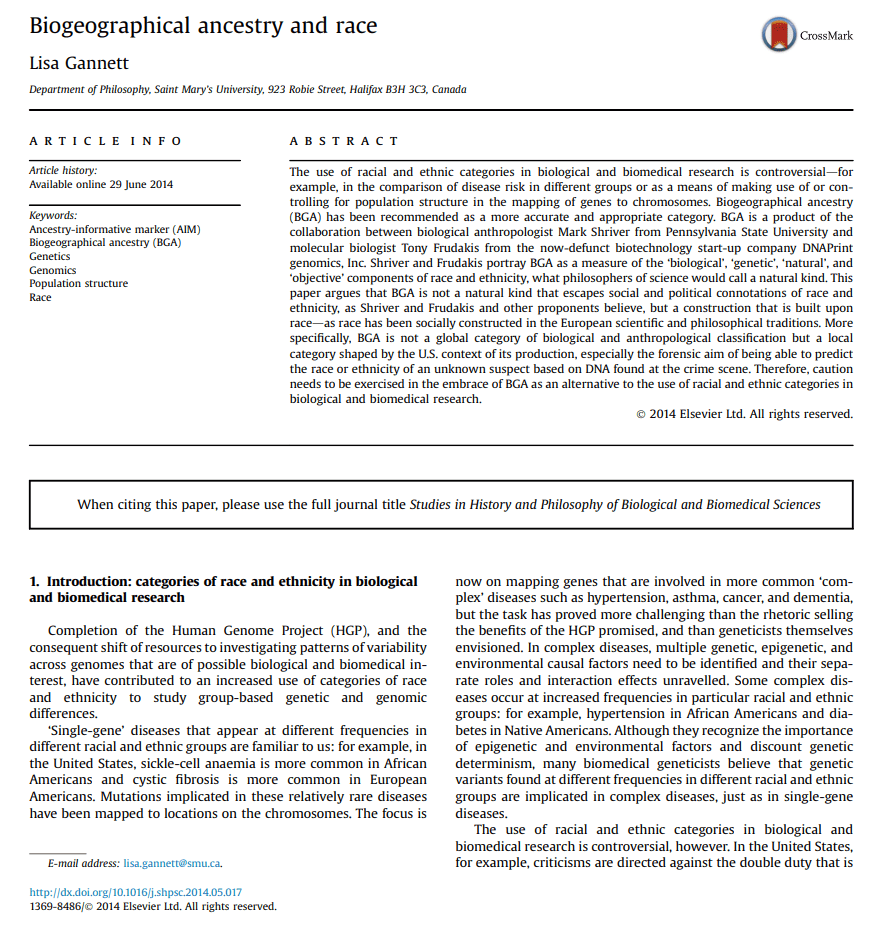
Eventually, with additional research, I published this paper:
As a bit of a lark, I took a detour on my way from London to Exeter, the site of the conference, getting off the train at Taunton and then taking a local bus to Langport. Having come this far, why not visit the “across the pond” home of my father’s and brother’s Y-chromosome?
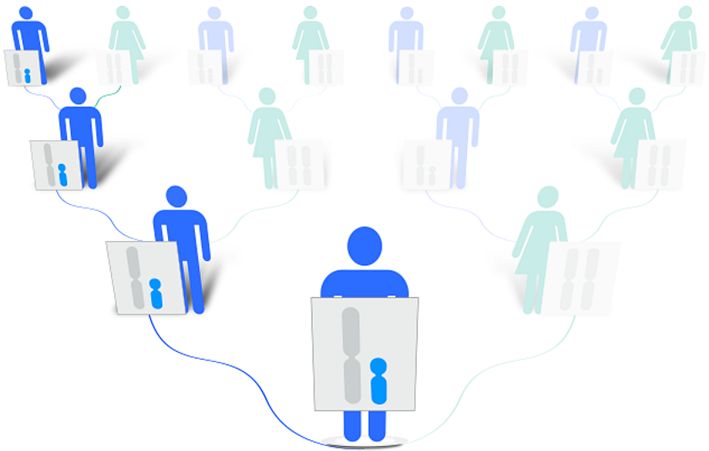
Dabbling while preparing my conference talk, and having begun as most neophytes do with one’s own surname and therefore a paternal and masculinist bias, I discovered that my father’s grandfather had been born in this area of Somerset, England. His father was a hurdle-maker: he made fencing for sheep-herding; his mother’s father was a baker. In 1857, as a five-year-old, accompanied by his father, stepmother, and younger sister, he sailed from Liverpool to New York. The young family settled on a farm in Huron County, Ontario, and the boy grew up to be a blacksmith and farm implement agent. He died in Wingham in 1935, just a couple of months after my father was born, of emphysema and chronic bronchitis. This is not very much to know about a person’s life, but I had known nothing at all.
Waiting at a bus stop in Taunton, I asked a woman if “Gannett” is a name found in those parts; she seemed to find it a strange question, and honestly, I felt strange asking it. But the visit was an enjoyable side-trip.
Langport is a pretty town. Located near where the River Yeo meets the River Parrett, Langport served as a busy river port and commercial centre until the railroad arrived in the 1850s. Basket-weaving has long been a thing: most of the willows that grow in England grow in the wetlands surrounding Langport, where willow shoots — called “wilthies” — have been harvested, boiled, and woven into baskets and other products for thousands of years. On this sunny day in July, I walked along Bow St, stopped at a bookstore and bought my father a local work of historical fiction, and continued uphill to All Saints church, where I found the grave markers in the yard to belong to people far more influential — essayist and economist Walter Bagehot among them — than my humble relations.
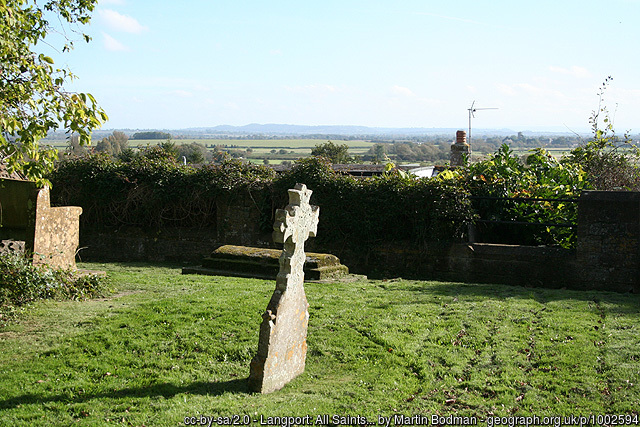
Only later did I realize that Langport was the civil registration district for births, marriages, and deaths, and the smaller, outlying villages of Fivehead and North Curry — and their respective churches of St Martin’s and St Peter and St Paul and parish records — would have been far more relevant.
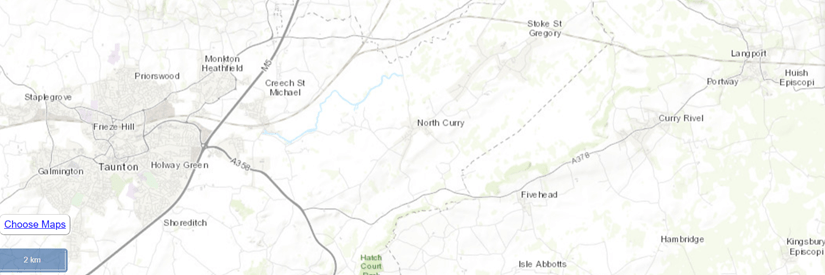
I almost wrote “more relevant to my search.” That’s the way the genealogical narrative tends to go. Yet, I wasn’t really searching for anything, at least that I was conscious of. And after having taken this excursion to Taunton and Langport, I wasn’t quite sure what I was supposed to feel. Perhaps a grave site for the baker’s daughter — at St Martin’s in Fivehead, the actual church where she was buried — would have provided a more tangible connection to the past: she died so young, with a son of only two years and a daughter of only six months, who soon embarked on a life in Canada without her. But what does that past have to do with me? Am I to understand myself differently? Am I to live my life differently?
The conference trip to England was in 2007; since then, interest in genealogy, especially in North America, has continued to increase exponentially — driven in turn over these past several decades by access to computers, the internet, digitization projects, and DNA technologies. The search for identity is taken for granted. The TV and internet ads are insistent and incessant. Who am I? Where am I from? What makes me unique? “I,” “I,” “I”. “Me,” “me,” “me”. As the 23andMe ad says, “Welcome to you.”


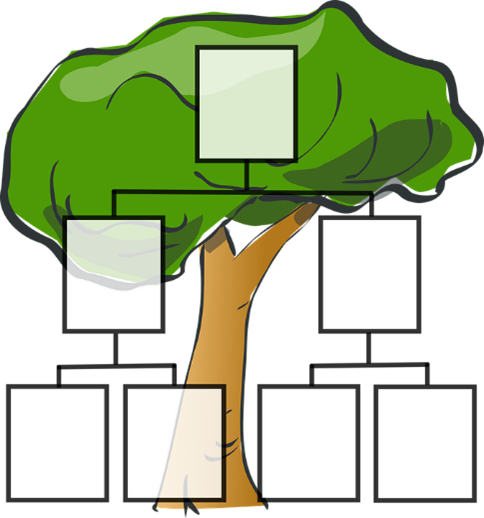
Though I retain a sceptical outlook, I do now find genealogy interesting. Even on my way to the conference, I realized that I was being overly critical. On the overnight flight, I sat beside a woman from Antigonish, Nova Scotia, who, if I recall correctly, was a McDonald (or MacDonald) on both sides and had been doing genealogy for many years. Even though I was in dire need of sleep, having put in too many late nights trying to pull a presentation together, I stayed awake and we talked throughout most of the trip. She told me some of the many things she had learned about the social and economic conditions of particular places at particular times and changes in these conditions across generations. She approached genealogy by tracing lateral branches of the family tree, refusing to privilege “blood” relatives, and being attentive to the communities in which people lived. I have found this to be sage advice.
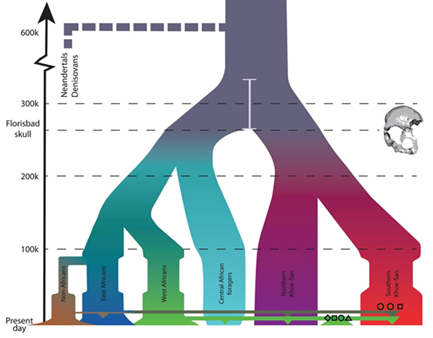
As a historian and philosopher of science, I continue to be interested in how group identities are constructed by scientists in human evolutionary history and population genetics. I have come to be interested in how group identities are constructed by family historians, through the use of both traditional and genetic genealogical methods. Both fields exploit the genealogical construction of identity: they seek to make sense of the present by reconstructing shared pasts of posited origins and branching lineages.
The genealogical construction of identity gives rise to numerous philosophical questions that I will try to address in future posts. Why have concerns about identity become so pressing in contemporary society, at least for some people? Why is genealogy so popular as a means of addressing concerns about identity? What contingent choices are made about fixing origins and following branches, and why these choices? How do current fascinations with genealogical constructions of identity impact ideas of collective belonging in a multicultural country such as Canada with a sizeable number of recent immigrants? How might genealogy might be used as a tool for doing history in a way that promotes better understandings of the ways in which centuries of imperialism and colonialism have benefitted some and harmed others?
 Lisa Gannett