
In his petition to the General Court, John Wallis said he desired a dispensation or divorce “to secure him from any penalty of ye Laws Respecting Polygamy” should he marry another.
Polygamy was not theoretical as a prospect for John. Although divorce cases were not common in early 18th-century Connecticut, in February 1722/23,1 David Scott was sued successfully for divorce by his wife, Mary Scott, on the grounds he had entered into a second, polygamous, marriage and willfully deserted her for more than three years. David Scott was neighbour to the Burts and Wallises at both Mamanasco hill — presumably, Scotts Ridge is named after him — and Ridgefield’s town plot, where his home lot lay immediately south of Benjamin Burt’s across what is today Catoonah St. David Scott’s stepson, Vivus Dauchy, became brother-in-law to John Wallis, when he married John’s sister Rachel Wallis.
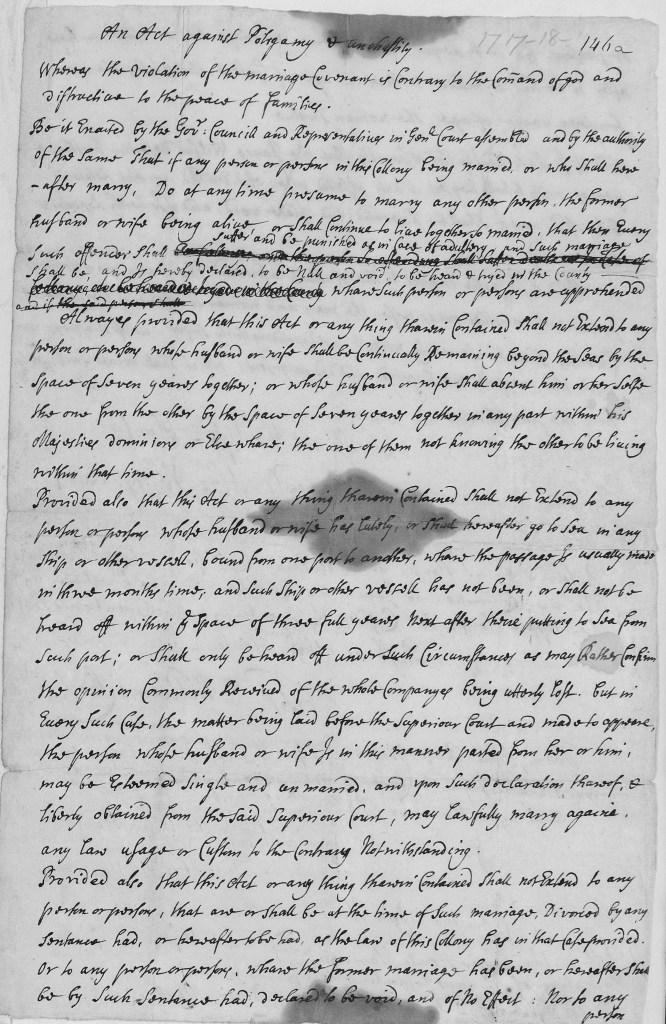
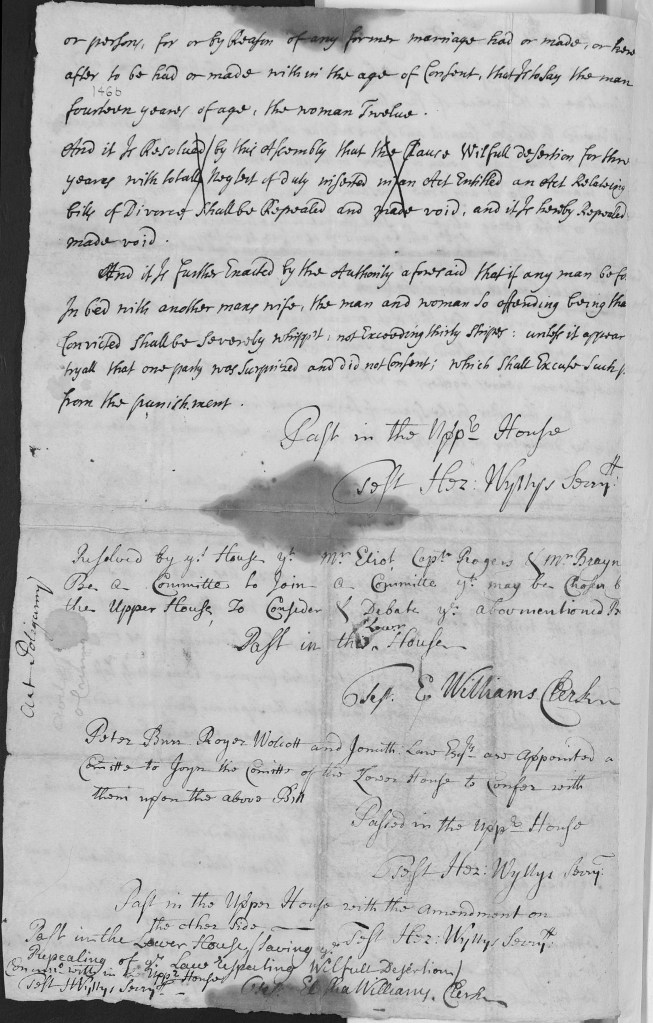
“An Act against Poligamy & unchastity” was passed in the General Assembly of the Connecticut colony in 1717/18. The act forbid anyone already married, with a spouse still alive, to enter into another marriage. Exceptions included divorce, seven years of separation, three years of “willful desertion,” and marriage prior to the age of consent (14 for males, 12 for females). Otherwise, “Every Such offender Shall suffer and be punished as in Case of adultery and Such marriage Shall be, and Is hereby declared, to be Null and void.”
David Scott emigrated from Londonderry, Ireland, leaving behind a family — wife, Mary, and children, James and Elizabeth — only to have that family join him in Connecticut some years later, presumably unexpectedly, after he had married again. In Silvio Bedini’s Ridgefield in Review and Donald Lines Jacobus’s “The Scott Family of Ridgefield, Conn.,” we learn that on April 21, 1719, Mary Scott, formerly of Londonderry and now of Ridgefield, brought suit in Fairfield County Court against her husband, David Scott, who did not appear in court. Apparently, the judges awarded Mary Scott three acres and 72 rods of David Scott’s home lot.2
David Scott had become a Ridgefield proprietor on June 2, 1712, when for 45 pounds, he bought the 1/28 proprietor right of the deceased Jonathan Stevens from his mother, Mary Bouton, a Norwalk widow. David Scott was described in that deed as “of Late resident in ye Town of Fairfield,” but he was living in Ridgefield by the following spring. The lands laid out to Jonathan Stevens and transferred to David Scott are found in Ridgefield land records, dated March 16, 1716, and follow a series of quit claims from Mary Bouton’s other children (half-siblings to Jonathan Stevens).
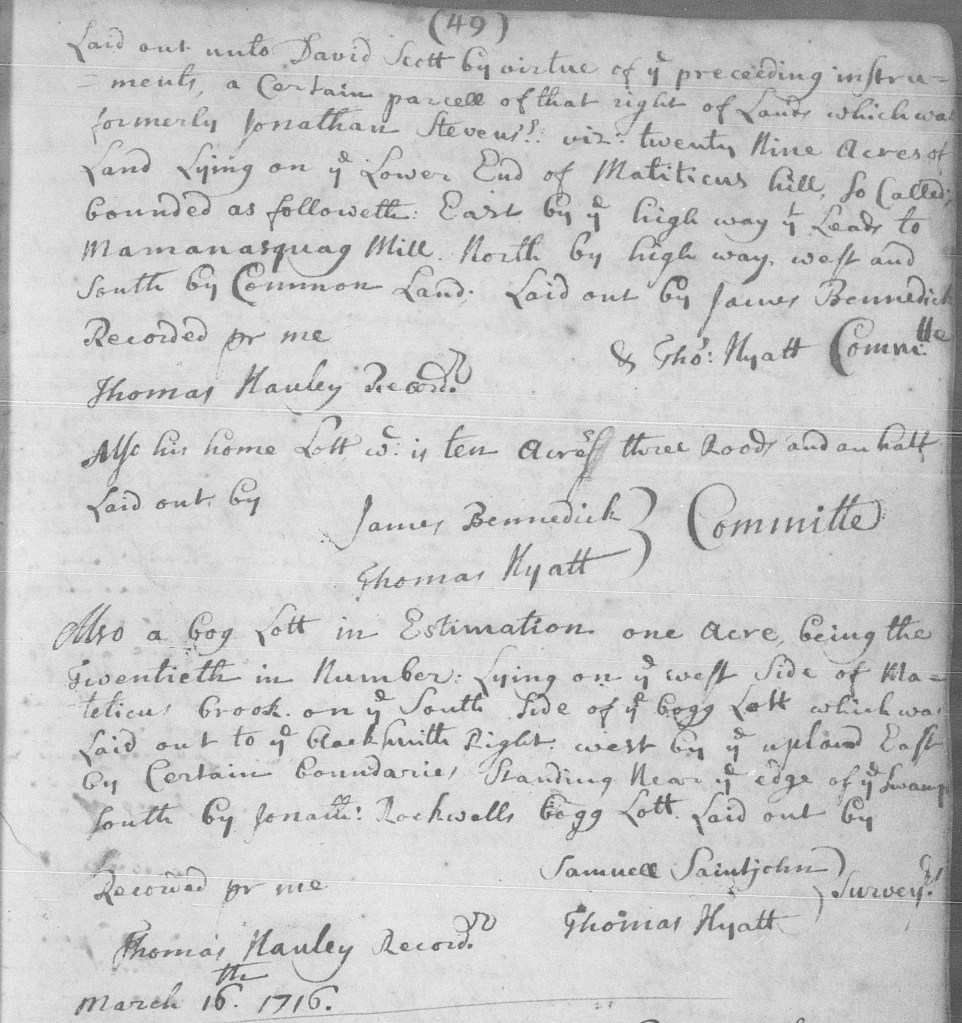
The 10-acre, 3.5-rod home lot laid out to Jonathan Stevens in the first division of lands was No. 13, the northernmost lot on the west side of Town Street, which faced the home lot of Thomas Smith to the east and was bounded by the home lot of John Sturdevant to the south.

The three acres, 72 rods of David Scott’s home lot awarded Mary Scott by the Court is consistent with the dower’s right to one-third of her husband’s personal and real estate at his death for use throughout her natural life or as long as she remains his widow and does not remarry.
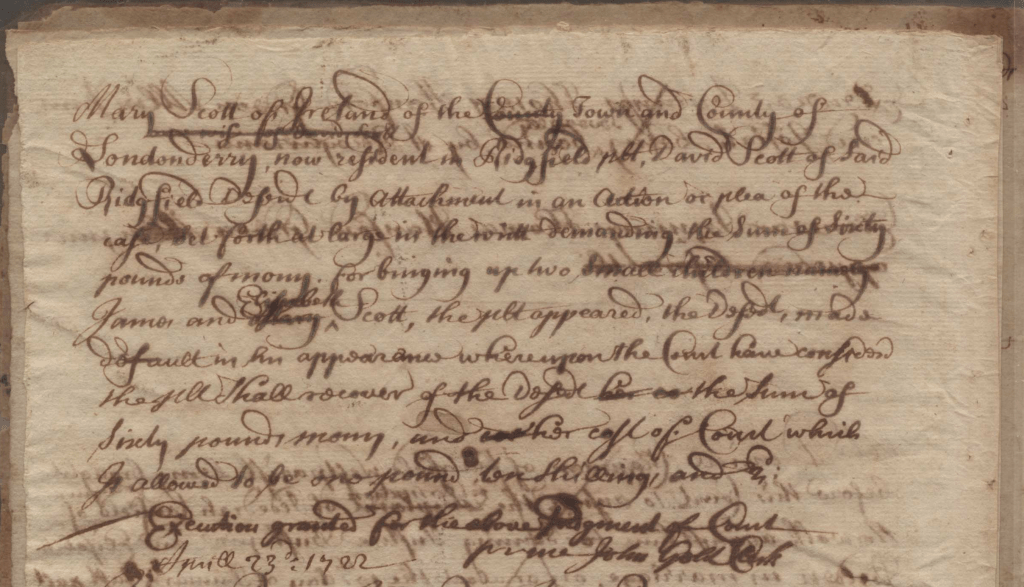
Also in Fairfield County Court, on April 22, 1722, the court executed the decision made in 1721 that Mary Scott would receive 60 pounds from David Scott “for bringing up two small children namely James and Elizabeth Scott.”
The children could not have been too small, however, since by this time, David Scott had deeded land rights to his and Mary’s son, James, who in turn deeded land to his sister, Elizabeth. On March 17, 1721 (double dating not provided, but based on sequence of records, likely year was 1720/21), for “Love and Fatherly affection,” David Scott transferred to his son, James Scott, of Ridgefield, one full and exact half of his Ridgefield proprietor’s right, though he reserved the whole of his home lot and several additional pieces of land, including two pieces near Blacksmith Ridge, for himself. On the same day, for “Love and Brotherly affections,” James Scott transferred 40 acres of land to his sister, Elizabeth Scott, also of Ridgefield: a tract of about 30 acres by Peespunk Brook and the balance of about 10 acres from his interest at Mamanasco.3
Mary Scott subsequently petitioned for divorce. Addressing the Superior Court justices in Fairfield on February 26, 1722/23, Mary Scott charged David Scott, her “Lawfull Wedded husband,” with committing “the sin of Poligamy” for having married Elisabeth Dacee about 11 years ago. Mary specified as grounds for divorce that David Scott had “Wilfully Absented himself for more than the space of three years.”
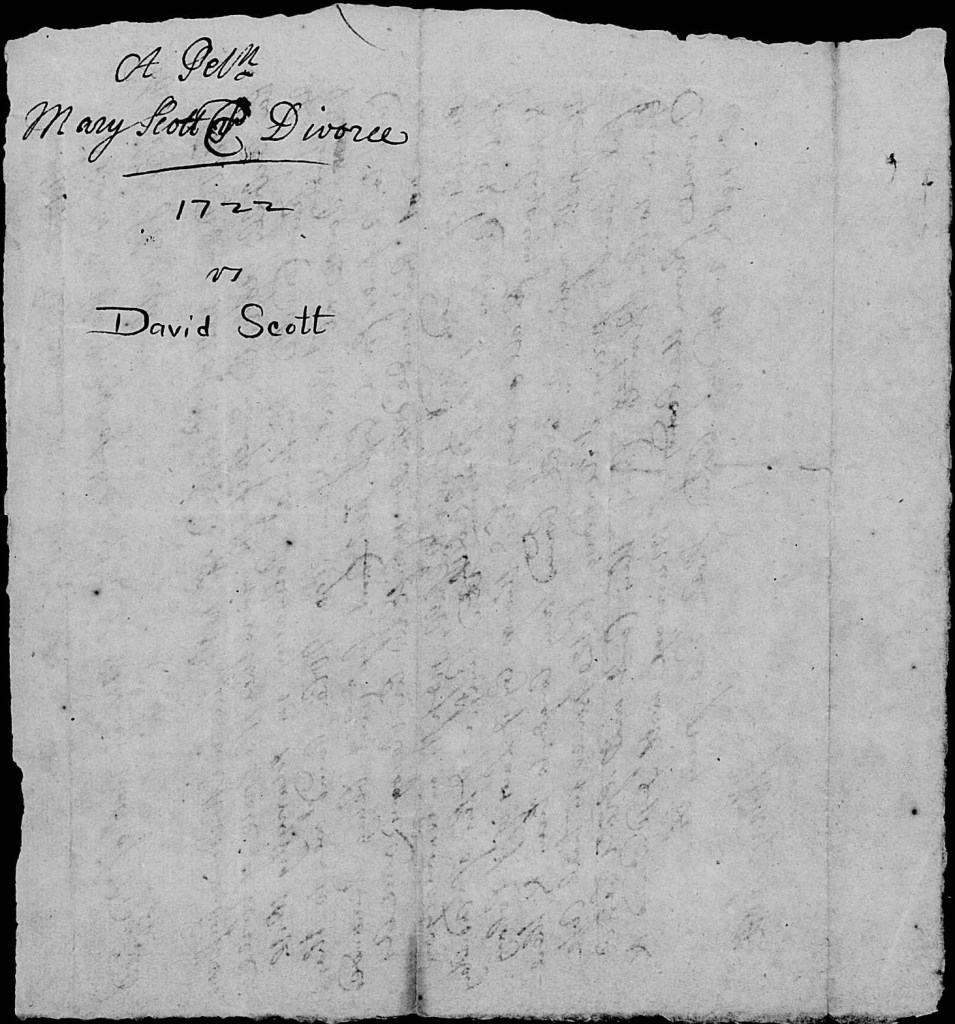
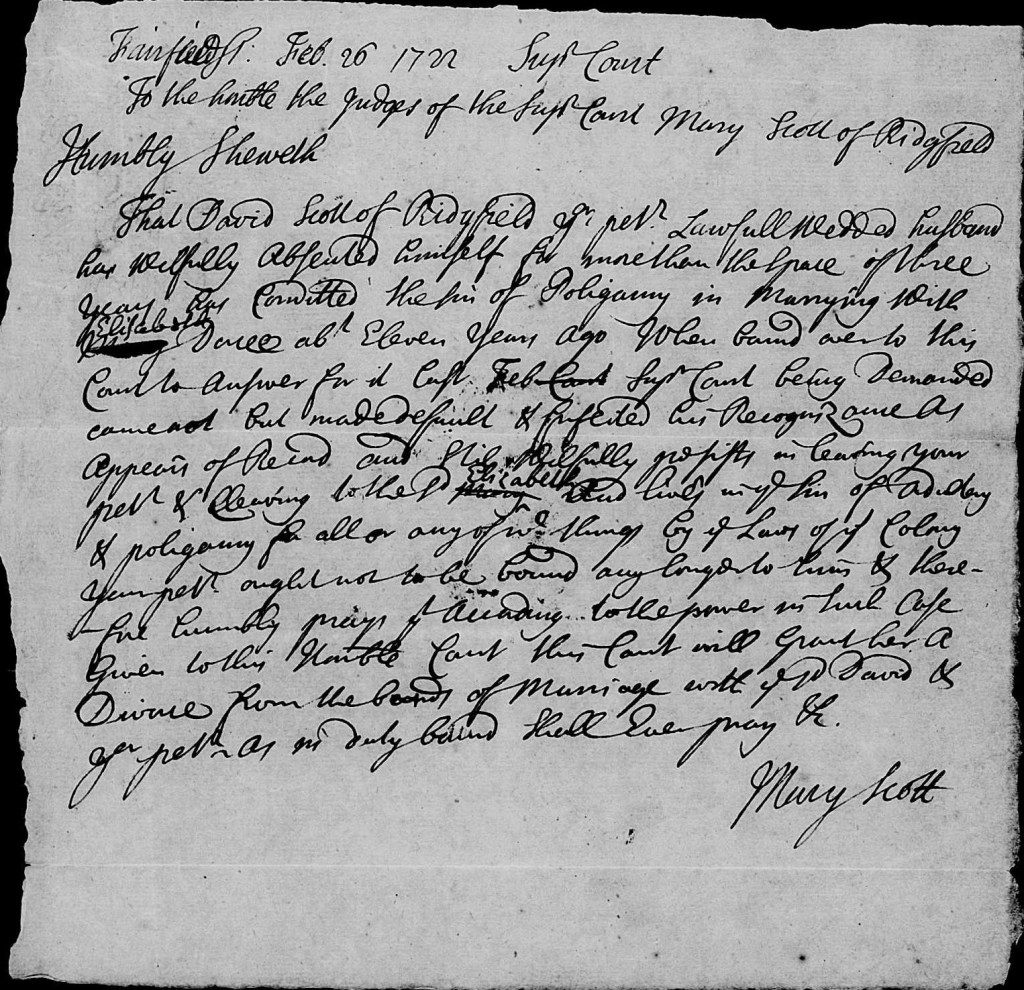
In her testimony, Mary Scott noted that the previous February, David Scott had failed to appear in Superior Court to answer the charge of polygamy “but made default & forfeited his Recognizance as Appears of Record.”
Indeed, the Superior Court record shows that despite being bound on November 21, 1721 in a recognizance of 50 pounds for his appearance at the court held February 1721/22 “to answer to a Complaint made against him for his being Guilty of the sin of Polygamy,” David Scott “being three times called to come forth & Save himself and his Bail, he appeared not.”

And Joseph Keeler and Benjamin Stebbins, both of Ridgefield, who were bound in a recognizance of 25 pounds each to deliver David Scott to that court, despite being called three times, had failed to do so. The Court ordered Keeler and Stebbins to appear before the Superior Court in Fairfield the following August to show cause why their bond should not be forfeited.
However, David Scott had taken steps to indemnify his bondsmen, perhaps because he had no intention of travelling to Fairfield on the last Tuesday of February 1721/22 to answer Mary Scott’s complaint.
On November 21, 1721, the total bond of 50 pounds advanced by Joseph Keeler and Benjamin Stebbins was secured by Scott’s one full half of a proprietor’s right (i.e., 1/60th part of right in all divided and undivided lands) shared equally by Keeler and Stebbins (the other half having already been transferred to his son, James Scott). On December 23, 1721, David Scott transferred the one full half of his proprietor’s right securing the bond paid by Keeler and Stebbins to Alexander Resseguie for 200 pounds. A June 1722 land record notes that after Scott failed to appear in court, Mr. Alexander Resseguie of Norwalk, attorney for David Scott of Ridgefield, reimbursed Keeler and Stebbins the 50 pounds and paid 11 shillings for their travel from Ridgefield to Fairfield and half the charge of recording their mortgage with Scott. So by August 1722, Joseph Keeler and Benjamin Stebbins had already been made whole. (In May 1729, Keeler and Stebbins recognized having been indemnified by Scott and relinquished any claim to property.) In October 1722, for 200 pounds, Alexander Resseguie received a quit claim from David Scott for all his rights and interest in land and commonage in Ridgefield.
It was a different story for David Scott. Not only had Scott signed over his proprietor rights to Alexander Resseguie, he was in jail on February 26, 1722/23 when Mary Scott’s petition for divorce was heard in Superior Court at Fairfield. Elizabeth Scott testified on behalf of herself and her husband, David Scott, both of Ridgefield. On November 8th, the Scotts had been arrested “at the Suit of Mary Scott of Ridgefield.” Elizabeth had obtained bail so that she could appear in court to answer the complaint, but David remained a prisoner “in the Comon Goal.”
In her testimony, Elizabeth Scott recognized the facts as laid out in the the case. David Scott had failed to appear in court the previous February to answer the charge of polygamy, despite his bond of 50 pounds, and in doing so, in the eyes of the court, this was sufficient to establish his guilt: “That by making default he Confess himself Guilty of ye Sd Polygamy.” Nevertheless, David and Elizabeth “Since ye Feb. Court have at Sundry times Continued to live together as husband and wife.” This was against Mary Scott’s wishes for “the Law to reclaim them from their Wickedness,” record their marriage as “null & void,” and forbid Elizabeth from living with David.
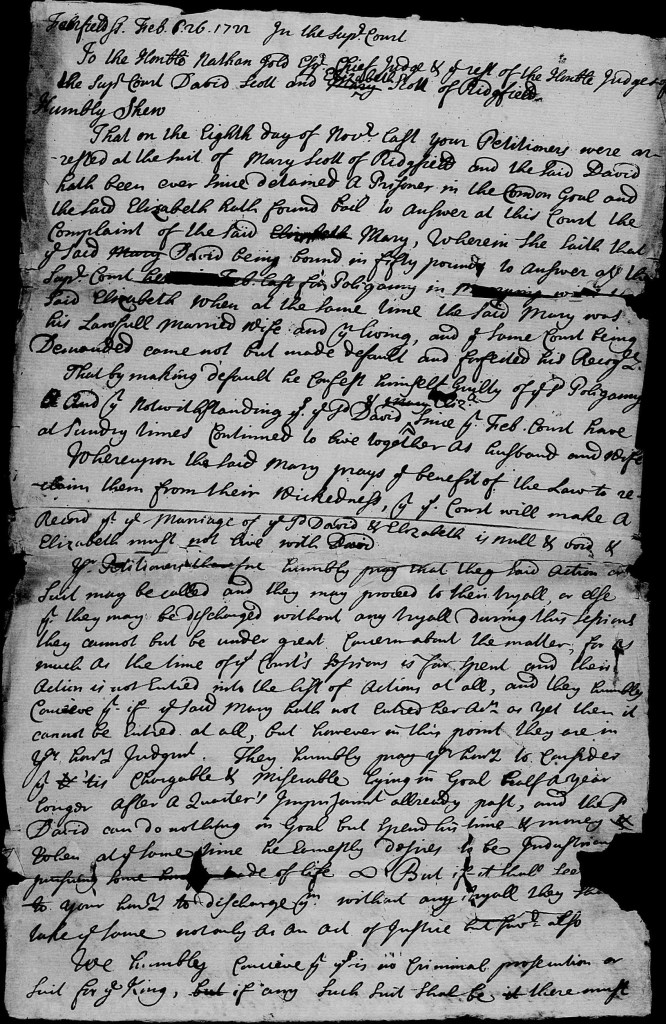
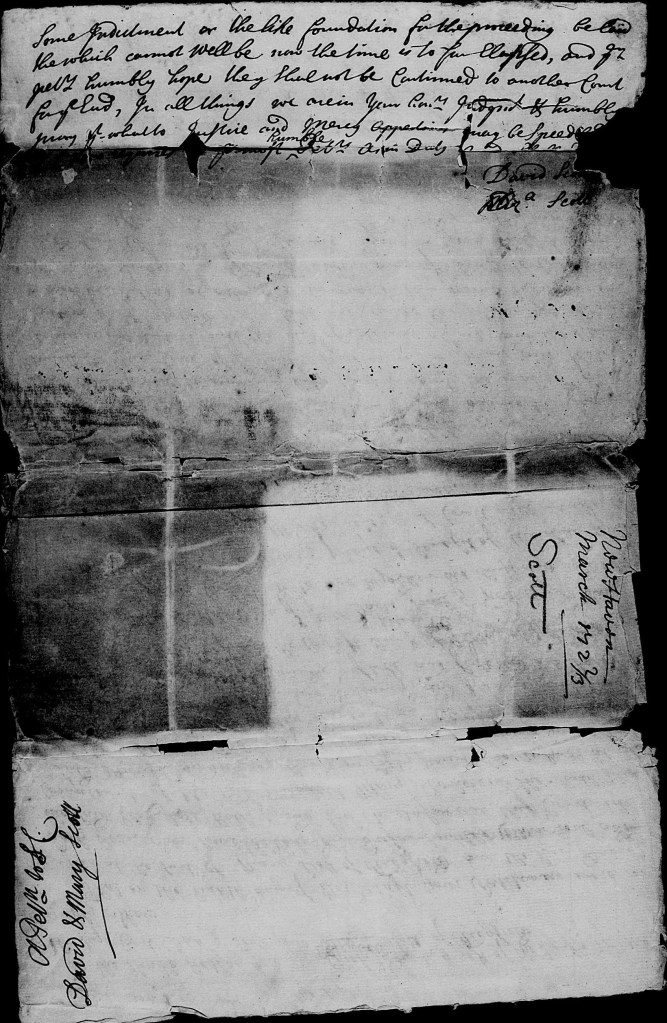
Elizabeth asked on David’s and her own behalf that the Court call the action against them so they would either proceed to trial or be discharged without trial during the current session. Should their case be carried over yet another session, David faced a “Miserable lying in Goal half a year longer.”
On March 2, 1722/23, the Superior Court issued its decision and granted Mary Scott the divorce she sought, ruling that “by the Laws of this Colony,” she ought to be “discharged from her Bonds of Marriage.”
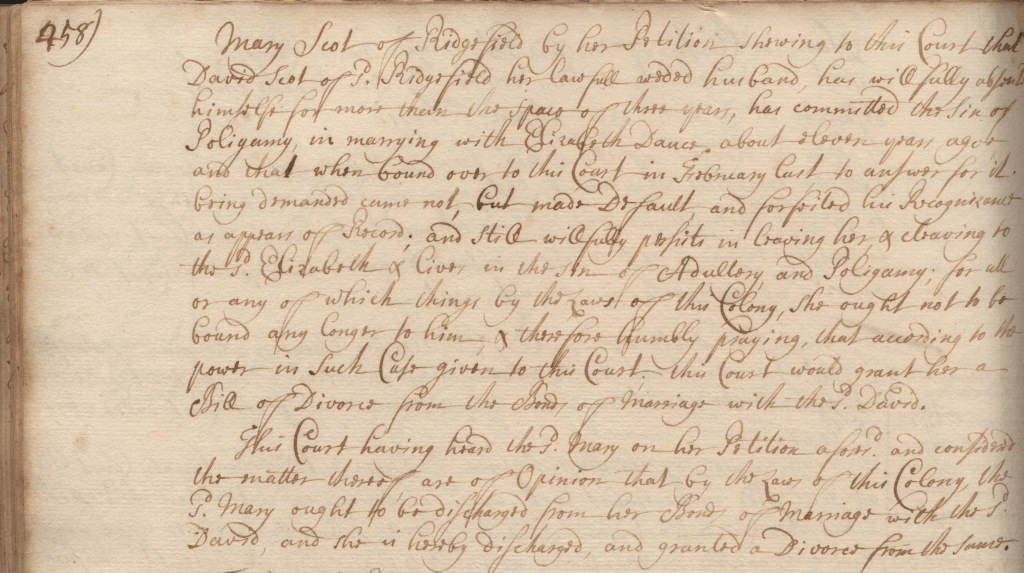
The Court commented on David Scott’s failure to appear in court the previous year to answer the petition brought against him by Mary Scott and that he continued to live with Elizabeth Dauce “in the sin of Adultery and Poligamy.”
Elizabeth Scott was called “Elizabeth Dacee” in the record of Mary Scott’s testimony and as “Elizabeth Dauce” in the record of the Superior Court’s judgement. This is Elizabeth Dauchy, widowed mother of Mary Dauchy, who married Gamaliel Northrup in January 1723/24, and Vivus Dauchy, who married Rachel Wallis — John Wallis’s sister — in November 1732. In land records, David Scott referred to Vivus Dauchy and Gamaliel Northrup as “son in law,” an expression that at this time meant, in today’s sense, both stepson and son-in-law. A December 1733 allocation of land from the proprietors to Vivus Dauchy attributed Dauchy’s entitlement to “a Deed obtained of his father Scott.” Who was Elizabeth Dauchy Scott? Who was Dauchy, Elizabeth’s first husband and father of Mary Dauchy Northrup and Vivus Dauchy?
“Vivus” is an unusual name. Denis Fromentin alias Dauchy married Mary Vivers of Banbury, Oxfordshire, England at St Peter in Kineton, Warwickshire, England in 1671. A son of theirs named Vivers Dauchy was buried in Banbury in 1714 at about age 22. However, they had another son, Richard Dauchy, born in 1678, and a Richard Dauchy was living in Flushing on Long Island in 1705, when with permission of his wife, Elizabeth, he sold land in Huntington consisting of “two lotts which was sould to me by my Grandfather Bayley the one which he bought of Edward Higby and ye other of Nicholas Ellis.”
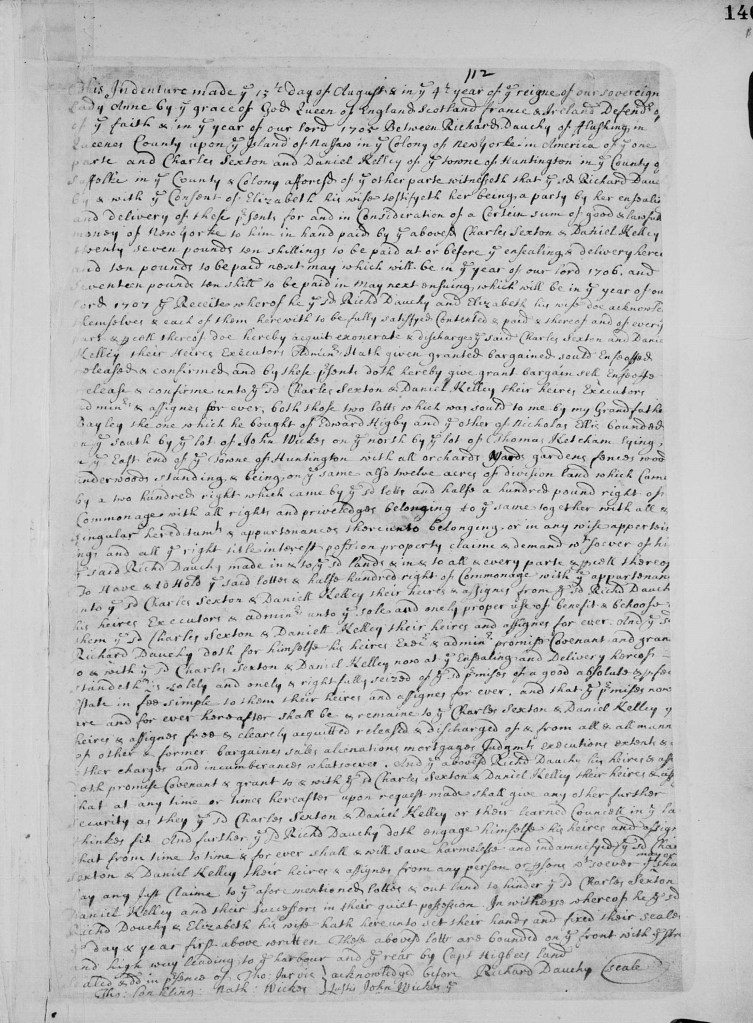
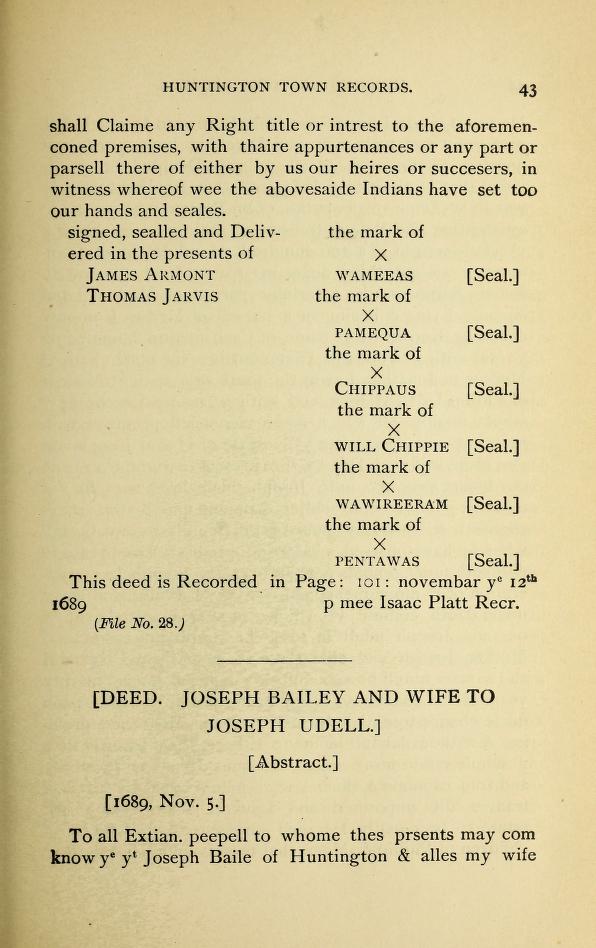
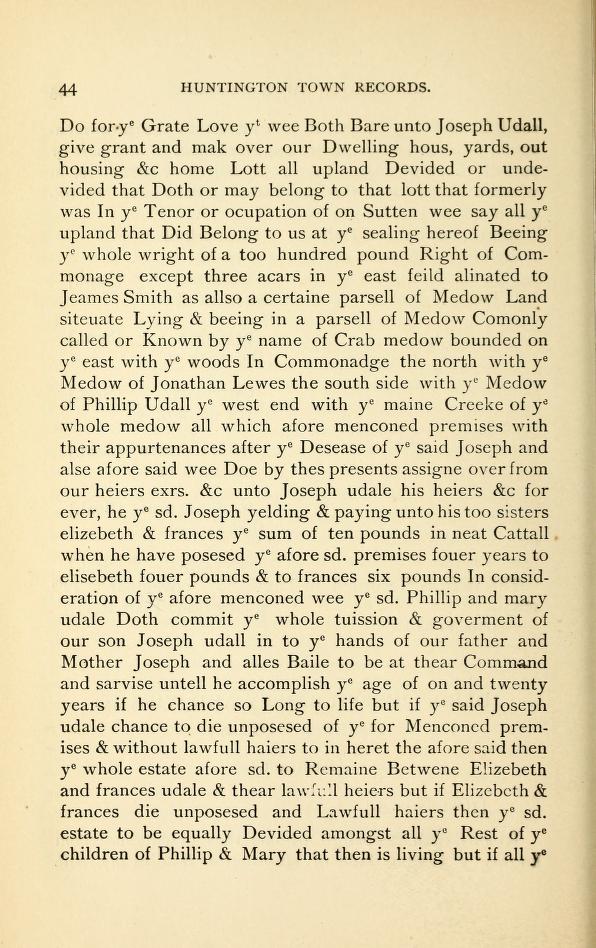
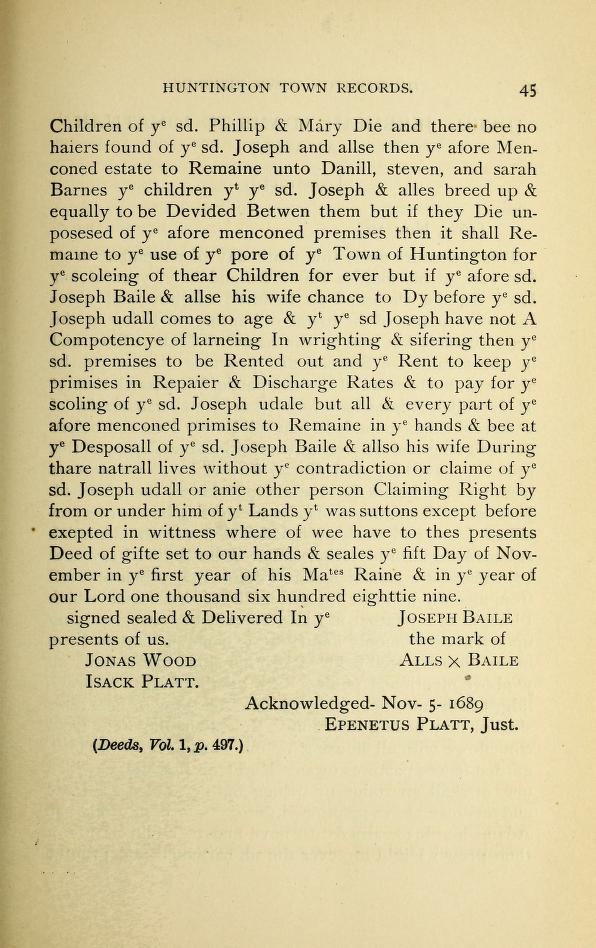
Grandfather Bayley is Captain Joseph Bayley of Huntington, married to Alice (last name unknown). These were Elizabeth’s grandparents. In a November 1689 deed, Joseph Bayley of Huntington and wife Alice out of “ye Grate Love” for their grandson Joseph Udall gifted him their dwelling house, home lot, and other lands under an agreement that his parents, Phillip Udall and Mary (Bayley) Udall, place “ye whole tuission & government” of Joseph in his grandparents’ hands until age 21. Granddaughter Elizabeth Udall was also mentioned in the deed: she was to receive a legacy, and if Joseph died without heirs, she was to share the whole estate equally with her sister Frances Udall.
Phillip Udall’s will, written December 2, 1714, confirms that Elizabeth Udall married Richard Dauchy, as his daughter Elizabeth’s share of movables was assigned to her son Beynes Docee’s use when he became 21. “Beynes” is similar enough to “Vivus” that this could be him.
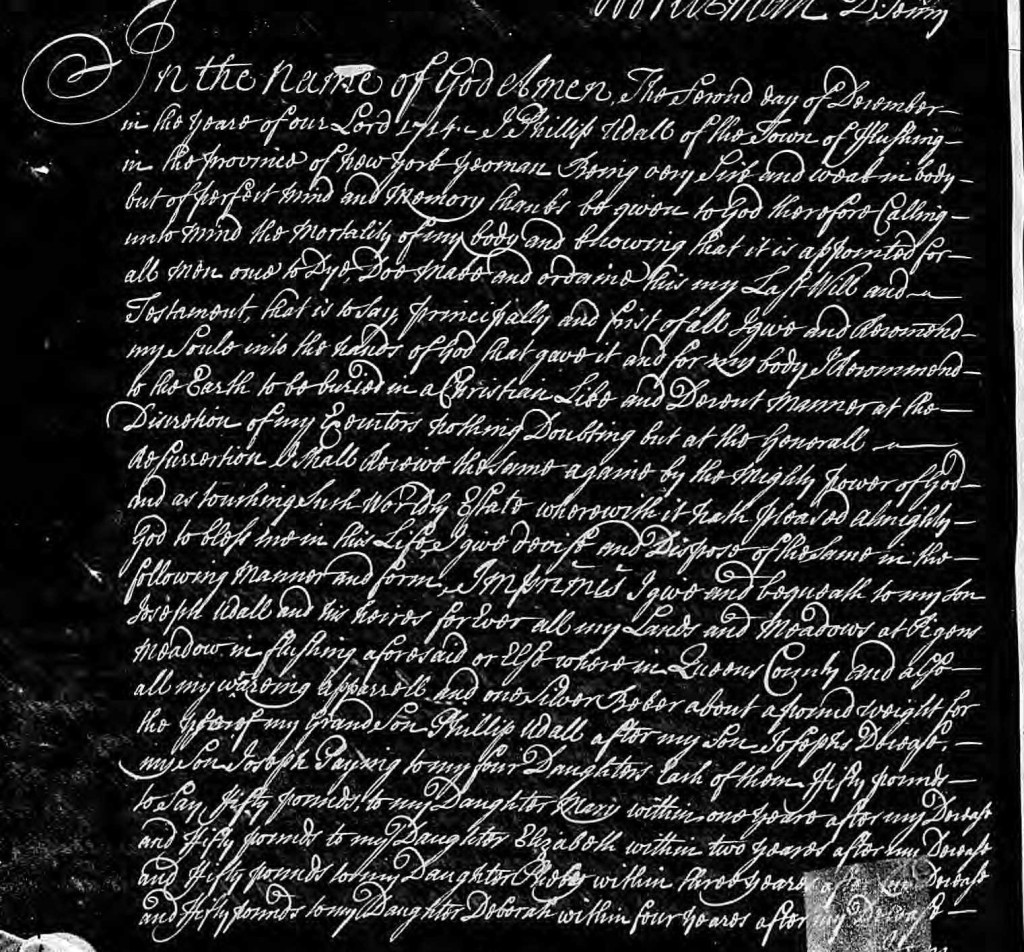
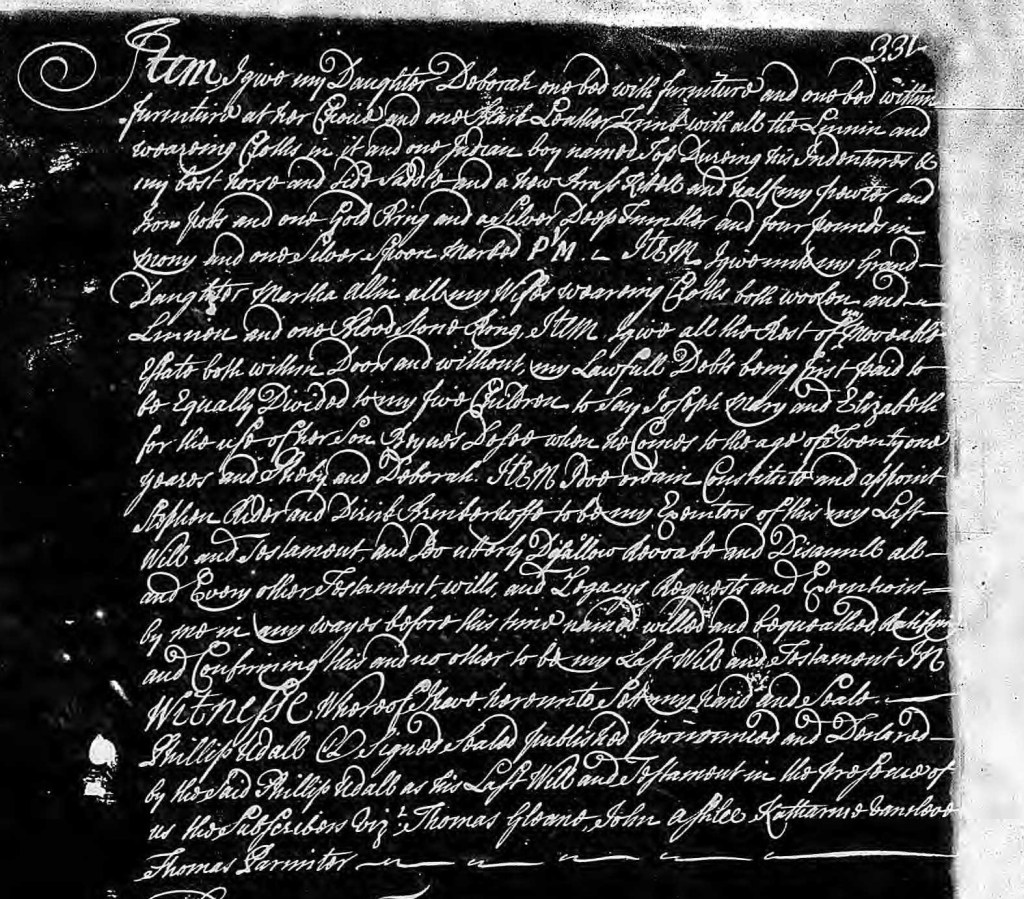
Note too that Phillip Udall “gave” his daughter Deborah “one Indian boy named Jop During his Indentures” — this fellow human being listed among movables alongside such items as a black leather trunk, a silver spoon, and Phillip’s best horse and side saddle.
According to Mary’s Scott’s testimony in court, David Scott and Elizabeth Udall Dauchy married around 1712. In 1712, when he bought Jonathan Stephens’ proprietor right, Scott was living in Fairfield. Richard Dauchy was alive in 1705 and living in Flushing on Long Island, when he and Elizabeth sold land she had obtained from her grandfather. Vivus Dauchy’s gravestone reads “In Memory of Capt. Vivus Dauchey who died Dec. 16, 1795: aged 88 years.” So he was likely born in 1707. Richard Dauchy must have died sometime between 1706 and 1712. Elizabeth Udall Dauchy and David Scott could have met after Richard Dauchy’s death in either Flushing or Fairfield.
David Scott maintained close relationships with Elizabeth’s children, as evidenced by his transfers of property to them. On May 14, 1725, David Scott’s one full half of a proprietor’s right was restored with a payment of 200 pounds to Alexander Resseguie, by then of Ridgefield. The following day, again for 200 pounds, Scott sold Resseguie one-quarter of a proprietor’s right in undivided lands, his entire one-half proprietor’s right in the New Purchase, and several additional pieces of land. In January 1731/32, David Scott, for 50 pounds, sold Vivus Dauchy one-half of his remaining quarter right as a proprietor in all common and undivided land. David Scott also gradually sold his home lot to Vivus Dauchy: in March 1729 [1729/30?], three acres and 31 poles off the lot’s upper end; an additional adjoining two acres as part of the January 1731/32 deed; and in February 1740/41, the dwelling house, barn, and remaining six acres of the home lot.
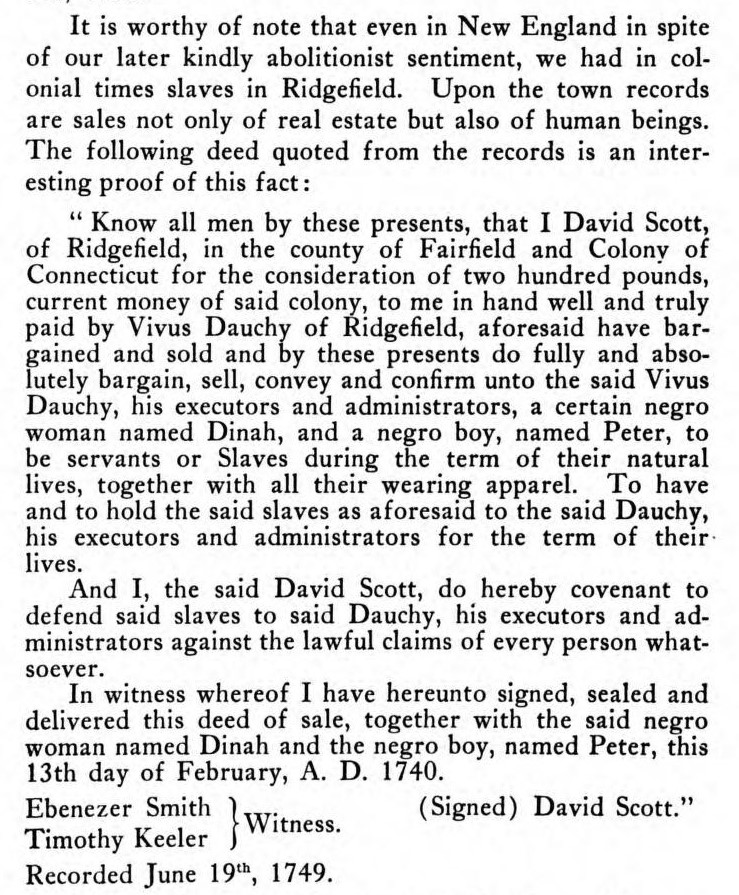
David Scott was a slaveholder. Property transactions with his stepchildren included enslaved human beings as well as real estate. In his 1927 The History of Ridgefield, Connecticut, George Rockwell uses a transaction between David Scott and Vivus Dauchy to establish the fact there was slavery in Ridgefield during colonial times. In February 1740, David Scott sold an enslaved woman named Dinah and an enslaved boy named Peter to Vivus Dauchy for 200 pounds:
In September 1746, “for & in Consideration of ye Love and Good will yt I have for, and do bear unto my Son in Law Gamaliel Northrup & Mary Northrup,” David Scott gave “for Ever my negro Child named Lidia, being About a year old” to his stepdaughter and her husband and their heirs and assigns to “Have Hold, Use & Peaceably Enjoy ye Sd negro Child.”
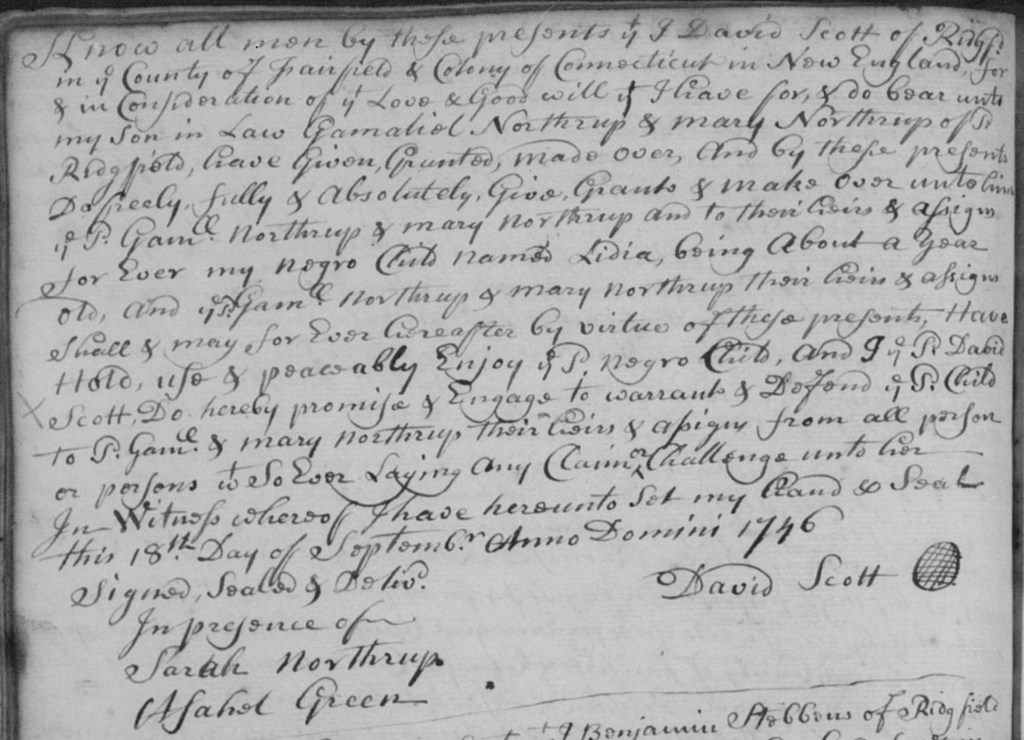
Gamaliel Northrup was already a slaveholder; in Ridgefield land records, we find a record of the July 21, 1739 birth of “Ishmael a Servant negro boy of Gamaliel Northrups.”

It may be that Lidia, the one-year-old girl David Scott referred to as “my negro Child,” whom he separated from her enslaved mother to gift her to Gamaliel Northrup and Mary Dauchy Northrup, really was his child and not merely a child he owned.
There was also a man named Quash held as a slave in the household of David Scott. In 1748, Scott gave notice to the town that “my Negro man Quash” would be freed upon his death. According to Ridgefield historian Jack Sanders, this may be the same “Negro man named Quash” who appeared again in town records in March 1780, having been found dead of exposure on the highway at Blacksmith Ridge.
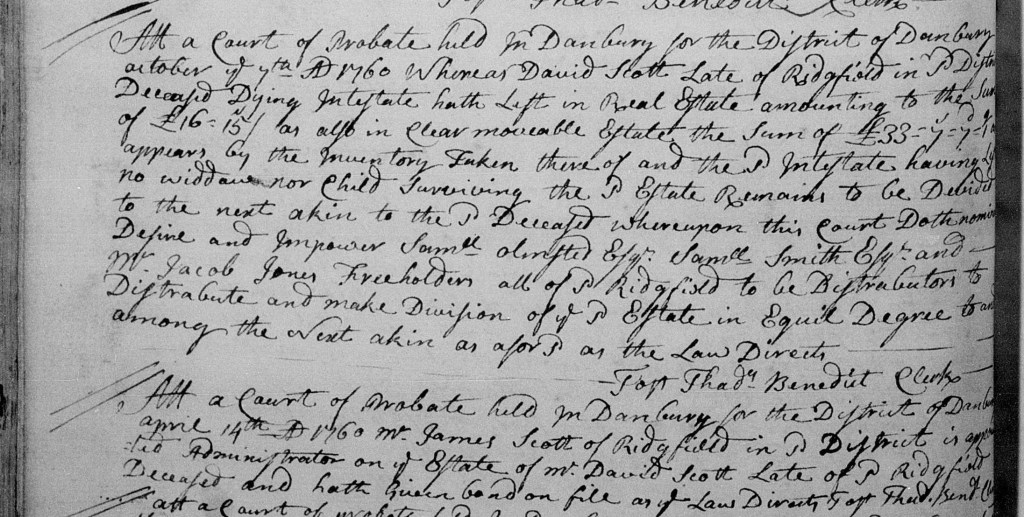
David Scott died on February 3, 1760. He died intestate, without a wife or children surviving him. His son, James Scott, died about 1750 (James’s widow, Hannah Hyatt Scott, remarried Samuel Saint John Jr., who had been widowed by the death of Sarah Wallis Saint John, sister of John Wallis.) David Scott’s grandson James Scott was appointed administrator on April 14, 1760, and inventory of the estate was taken April 28, 1760.
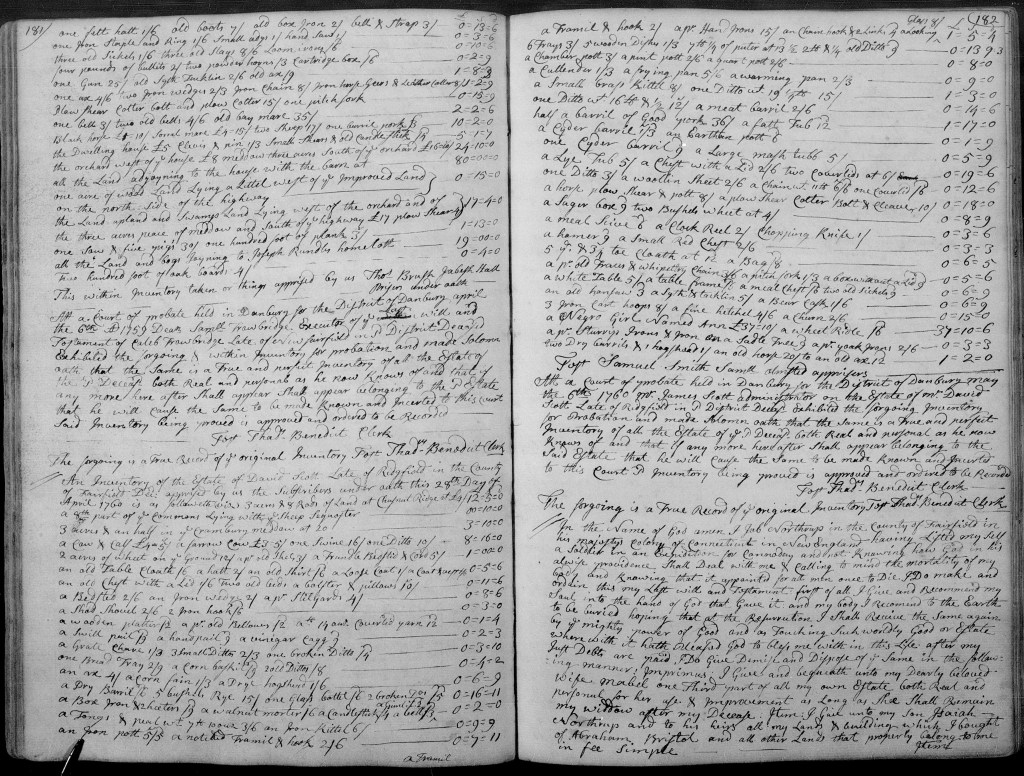
Included in the inventory of David Scott’s estate was “a Negro Girl Named Ann,” who was valued at 37 pounds, 10 shillings and listed among such mundane items as a “bear” cask, several iron cart hoops, and a churn. The enslaved Ann was by far David Scott’s most valuable possession — next most valuable was 3 acres and 8 rods of land at Chestnut Ridge worth 12 pounds, 5 shillings.
The Ridgefield Historical Society is located in the house built by David Scott around 1714 and added onto by Vivus Dauchy after he took possession in 1741.
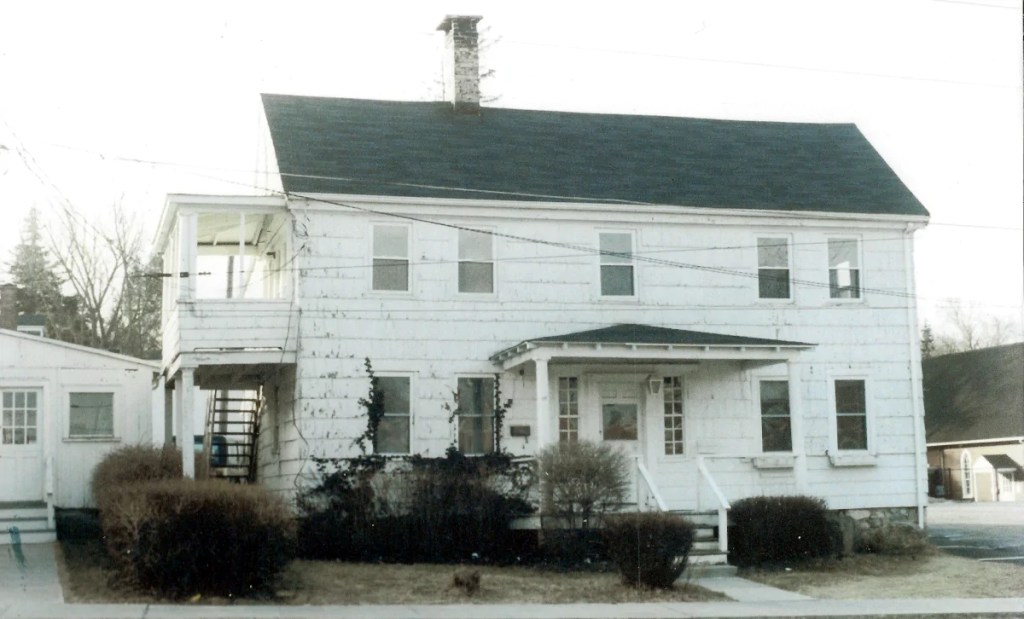
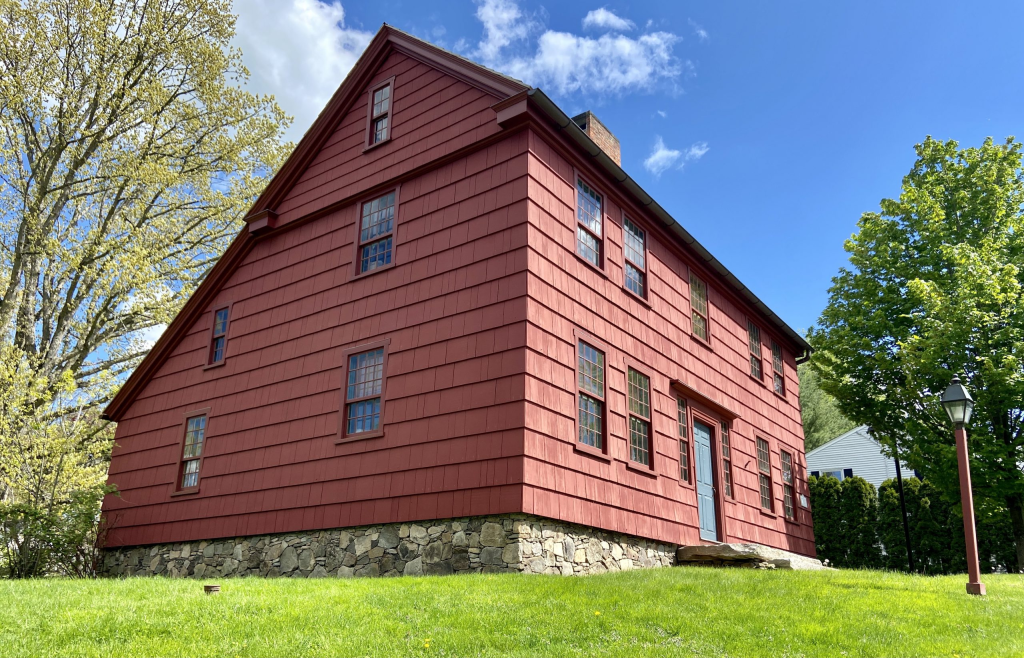
The Scott house originally stood on Main Street at the corner of Catoonah Street, but was moved a short way down Catoonah Street in 1922 to make room for modern buildings. Plans to demolish the Scott house in 1999 were headed off by an effort led by the Ridgefield Preservation Trust. The Scott house was rebuilt on Sunset Lane to house the new Ridgefield Historical Society, founded in 2001, complete with a climate-controlled basement vault for archival storage. The whole story can be found on the Society’s website.
It is fitting that the Scott house, preserved across more than three centuries, houses, in its new basement, archival records concerning Ridgefield and its history, some of which have been preserved across more than three centuries as well. The Scott house was built on one of the original home lots lining Town Street (later Main Street) assigned to Ridgefield’s early proprietors on land wrested from the region’s Indigenous people. The Scott house is a site that held people who were enslaved for their labour and where children were born into slavery. The terms of the British colonial project and the various forms of servitude and enslavement instituted to support that project contributed greatly to the wealth that David Scott and his two Ridgefield families and their families — the family of his son James Scott, the family of his stepson Vivus Dauchy, and the family of his stepdaughter Mary Dauchy Northrup — were able to accumulate and pass on to their descendants.
Much more needs to be said about the lives of Dinah, Peter, Lidia, Ann, Ishmael, Quash, and all others who were enslaved during the first 100 years of Ridgefield’s history.4 It is unfortunate that archival records disproportionately favour historical reconstructions of the lives of the wealthy and powerful — whether one’s historical interests are genealogical or academic, local or national, regional or global. What can be done is to investigate the history of slavery in Connecticut, the dynamics of the construction of racial difference in 18th-century New England, and how race and slavery shaped social and economic relations among Ridgefield families, which having been transmitted across generations exercise their legacies today. These are topics of future posts.
Footnotes
- The double-dating of years (e.g., 1722/23) reflects movement from the Julian calendar (introduced in 46 BCE by Julius Caesar) to the Gregorian calendar (introduced in 1582 by Pope Gregory XIII). The change occurred at different times in different places, largely a reflection of whether the population was Catholic (adopted earlier) or Protestant (adopted later). England and its colonies did not adopt the Gregorian calendar until 1752. Since the first day of the year was January 1st on the Gregorian calendar adopted elsewhere in Europe and March 25th on England’s version of the Julian calendar, to avoid confusion, “double dating” was often used January 1st and March 25th. More details are provided at this link. ↩︎
- This judgement awarding land to Mary Scott is not mentioned in Ridgefield land records. However, David Scott’s stepson, Vivus Dauchy, who purchased Scott’s home lot, subsequently received transfers and quit claims from David Scott and Mary Scott’s son, James Scott, and James Scott’s children. In May 1746, James Scott, then of Bethlehem, Hunterdon Co., New Jersey, provided a quit claim for two acres of land lying on the south side of “ye Lane Commonly Called & known by ye Name of Burts Lane,” bounded east by Town Street and south and west by Vivus Dauchy’s land. James Scott died around 1750, and in April 1753, for 3 pounds, 10 shillings, his sons James Scott and David Scott Jr. of Ridgefield deeded Vivus Dauchy 48 rods of land “in ye Easterly part of ye Lott Originally our Grandfather David Scotts,” bounded east by Town Street, north and west by Dauchy’s land, and south by “ye Land of Joseph Parkers heirs.” Joseph Parker married David Scott and Mary Scott’s daughter, Elizabeth Scott, so his heirs were also David Scott’s grandchildren. ↩︎
- However, in November 1726, Elizabeth Scott alias Parker, of New Castle, Philadelphia, was forced to appoint as attorney her husband, Joseph Parker, to recover land from her brother. In January 1726/27, Joseph Parker signed off on having received 26.5 acres at Peespunk Brook and 27 pounds for the remaining 13.5 acres (Elizabeth not having got land at Mamanasco) from James Scott. ↩︎
- Jack Sanders’ forthcoming Uncle Ned’s Mountain attempts to recover as much of that history as possible. ↩︎
References
Books and articles:
Bedini, Silvio A. 1958. Ridgefield in Review, The Ridgefield 250th Anniversary Committee, Inc., Ridgefield, CT; https://archive.org/details/ridgefieldinrevi00bedi
Jacobus, Donald Lines. 1968. “The Scott Family of Ridgefield, Conn.” The American Genealogist 44 (1): 9–14.
Rockwell, George L. 1927. The History of Ridgefield, Connecticut; https://archive.org/details/TheHistoryOfRidgefieldConnecticut/
Sanders, Jack. forthcoming. Uncle Ned’s Mountain: Three centuries of African-American farmers, slaves, soldiers, and saviors in a small New England town. Expanded edition.
Street, Charles R., editor. 1888. Huntington Town Records, including Babylon, Long Island, N.Y. Huntington and Babylon, NY; https://archive.org/details/huntingtontownre02hunt_0
Archival materials:
Divorce Papers, 1720-1799 (Fairfield Superior Court) – Connecticut State Archives / Genealogical Society of Utah (available on FamilySearch)
Connecticut Archives Series, Crimes & Misdemeanors,
First Series, Vol. 2 (available on FamilySearch)
Land Records, Ridgefield Town Clerk (available on Family Search)
Acknowledgements
Thanks to Susan Bigelow, librarian at the Connecticut State Library, for help locating sources.
Thanks to the Dartmouth Family History Centre, and for help from Ann Smith, for access to historical and archival records reproduced by the Latter Day Saints.
Thanks to historian Jack Sanders for sharing his work and providing feedback and advice based on his extensive knowledge of Ridgefield, past and present. Jack’s books can be found here.
Copyright, December 2024, by Lisa Gannett — no reproduction or commercial use without permission of author
 Lisa Gannett