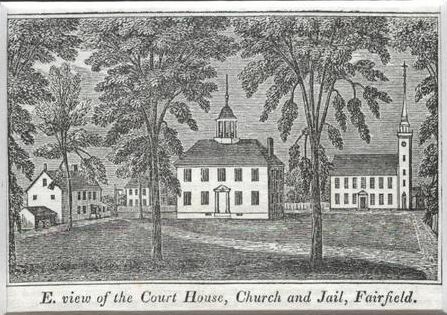
John Wallis petitions the Superior Court
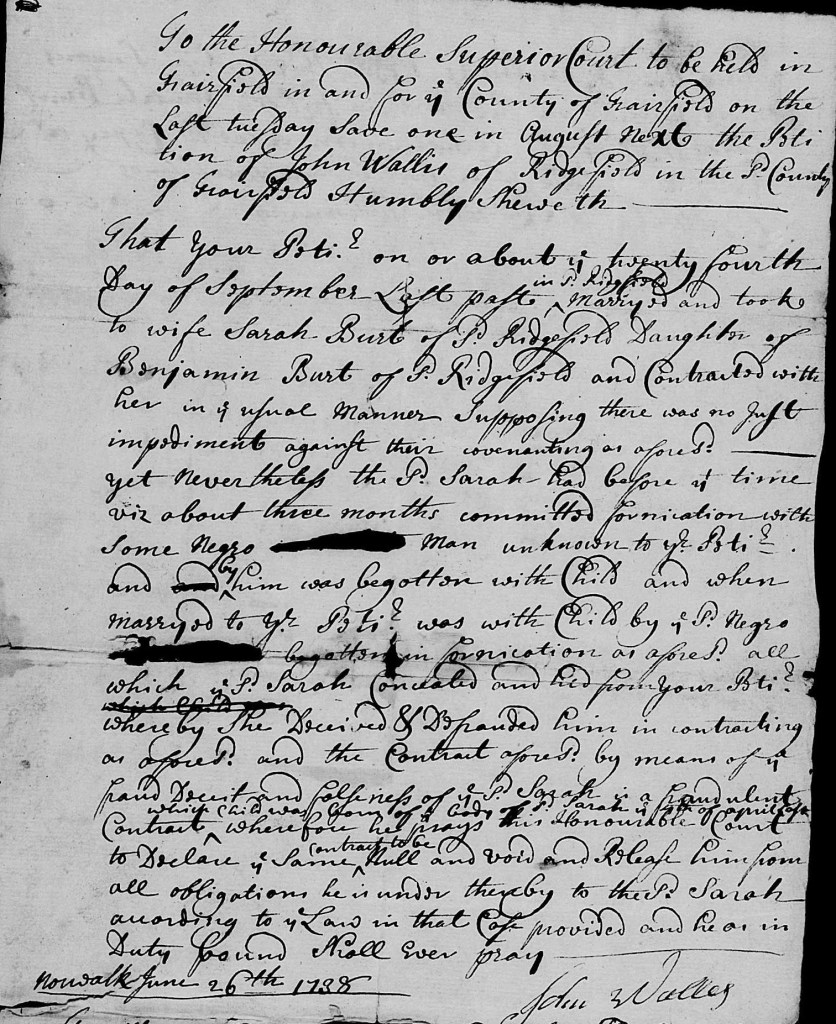
On April 4, 1738, at sundown, a child was born to Sarah Burt Wallis — or in the legalese of subsequent court records, this was “a Child Said to be born of ye body of Sarah Wallis alias Burt.” The child became the basis for a petition for divorce launched by Sarah’s husband, John Wallis, less than three months later, on June 26th of that year.
John Wallis and Sarah Burt had married on September 24, 1737, with Thomas Hauley, pastor of the Church of Ridgefield, officiating. Doing the math, the child arrived just over six months later. That might be thought the cause. However, John knew that Sarah was pregnant when they married. In an August 1738 deposition to the court, Justice of Peace James Benedict attested that about four or five days before John Wallis and Sarah Burt married, he was visited by James Wallis, John’s father, who requested that Benedict conduct his son’s marriage. (James Wallis and James Benedict were brothers-in-law, married, respectively, to sisters Mary Hyatt and Sarah Hyatt, daughters of Thomas Hyatt of Norwalk.1) Benedict asked Wallis why the couple was in such a hurry to marry, and Wallis answered, “She is Bigg they Say.” Benedict decided that without “Some Security” (presumably, the publication of marriage banns), he would not marry them.
So it was not the child’s early arrival that provoked John Wallis’s petition for divorce. Rather, it was the child’s appearance. Specifically, John believed that the child did not appear sufficiently White for him to be the father. In his June 26, 1738 petition, for a hearing on “the Last tuesday Save one in August next” to be held in Fairfield, Wallis asked the Superior Court to declare his marriage contract “to be Null and Void” and release him from all legal obligations because unbeknownst to him, Sarah “had before at time viz about three months [before their marriage] committed fornication with some Negro man” whose identity he did not know, and she had “deceived & defrauded” him by concealing the resulting pregnancy.
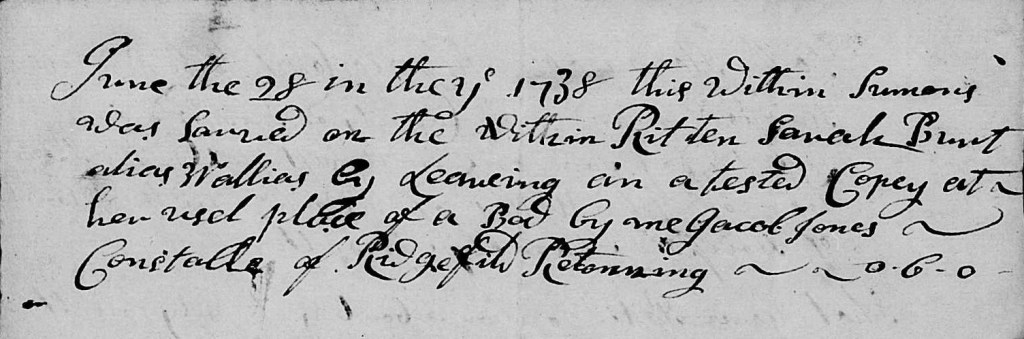
On June 28, 1738, “Sarah Burt alias Wallias” was served with a summons by Jacob Jones, Ridgefield constable.
Fairfield County Justices of Peace James Benedict, Joseph Platt, and Ebenezer Smith took numerous depositions from Ridgefield townspeople during August 1738.
Depositions from Lt. Richard Olmsted and wife Mary, Mrs. Hannah Smith, John Olmsted, Richard Olmsted, Jr., David Osburn and wife Rachael, and Rebecca Lobdell, wife of Samuel Lobdell (brother-in-law to Sarah’s brother Seaborn Burt, who married Susannah Lobdell), confirmed as common assumption that John Wallis married because “his Wife was Bigg.”
Townspeople disputed the racial appearance of the child in their testimonies. For example, Joshua Lobdell, with wife Eunice2 agreeing “in full with her husband,” said he had seen “a Child that was Said to be born of ye Body of Sarah Wallis ye Wife of John Wallis” in May and “Sundry Times Since” at the house of her father, Benjamin Burt, and the child “is now as white agin as it was ye first Time he saw Sd Child” (Susannah Lobdell, who married Seaborn Burt, was Joshua Lobdell’s daughter.) In contrast, for example, Hannah Sherwood, who also saw the child in May and “Some Considerable time after” at the Burt home, testified “And to my thinking I never See no English Child look so black, I See ye Child Some Considerable time after again, and it Seemed then to look a more yellowish black than when I See it before.”
Although John Wallis’s petition said he did not know the identity of the “Negro man” he supposed to have fathered Sarah’s child, accusations against Peter, an enslaved man held by Sarah’s father, Benjamin Burt, were made by Abigail Wallis (Sarah’s sister and wife of John’s brother James Wallis Jr.), Rachel Dauchy (John Wallis and James Wallis Jr.’s sister and wife of Vivus Dauchy), and Hannah Sherwood. Mary Northrup, wife of Gamaliel Northrup (and Vivus Dauchy’s sister), compared Sarah’s child, who she had seen in early June at the Burt home, with a mixed-race child fathered by slaveholder Timothy Keeler: “I then Saw ye face & hands of Sd Child, and to my thinking it was as Black, if not blacker then Timothy Keelers Mallotto Child that Come of his negro wench.”
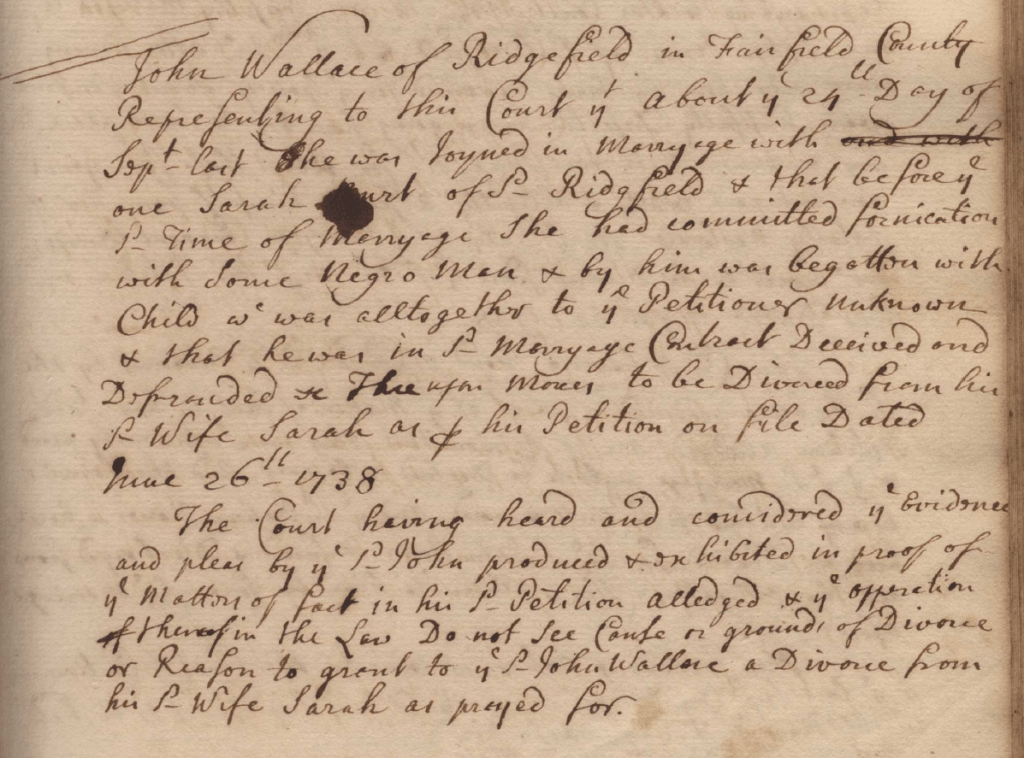
Having heard John Wallis’s pleas and considered the evidence and law in the case, the Fairfield Superior Court ruled August 22, 1738 that they “Do not See Cause or grounds of Divorce or Reason to grant to ye Sd John Wallace a Divorce from his Sd Wife Sarah as prayed for.”
John Wallis petitions the Connecticut General Court
In the Connecticut colony’s early years, divorces were granted only by the General Court. The Connecticut and New Haven colonies united in 1665, and the Court of Assistants was set up the following year. Legislation enacted in 1667 called for divorce cases to be heard in the Court of Assistants (called Superior Court from 1711). Grounds for divorce included adultery, desertion, fraudulent contract, and seven years’ absence (Cohn 1970, p. 39). This was John Wallis’s first step in June 1738, when he sent his petition for divorce to the Superior Court for a hearing at the August 1738 session at Fairfield.
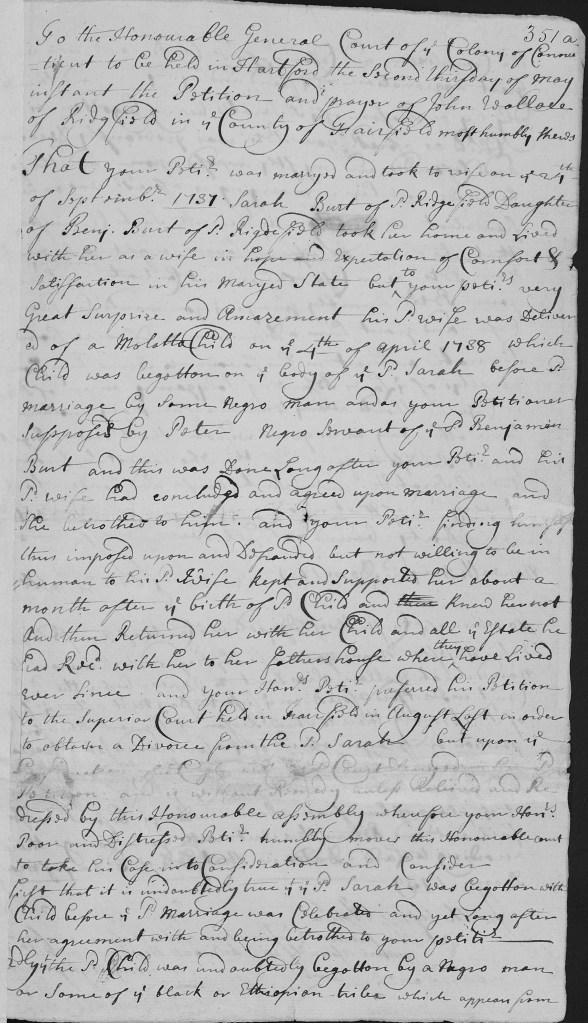
However, jurisdiction to hear divorce cases was retained by the General Assembly, which exercised its judicial function as the General Court, and petitions could also be submitted there, with both chambers hearing testimony and issuing decisions. Hence, John Wallis had recourse to submit to the General Assembly / General Court when his first petition was refused. So, the following year, on May 3, 1739, John Wallis petitioned the General Court of the Colony of Connecticut, to be held in Hartford on the second Thursday of that month, for a divorce from Sarah Burt.
In this petition, unlike the first, John Wallis named Peter, “Negro servant” of Benjamin Burt, Sarah’s father, as the man he supposed responsible for the “Molatto Child” to whom Sarah had given birth on April 4, 1738. John described his reaction as being one of “very Great Surprise and Amazement” and “finding himself thus imposed upon and Defrauded but not wanting to be inhuman to his Sd Wife kept and Supported her about a month after ye birth of Sd Child and knew her not And then Returned her with her Child and all ye Estate he had Recd. with her to her fathers house where they have Lived Ever Since.”
John made two additional points to argue his case. That “the Sd Child was undoubtedly begotton by a Negro man or Some of ye black or Ethiopian tribe which appears from the Complexion and Colour of ye Sd Child” was considered by John to be “a very Great aggravation of ye fraud and injury.” And finally, John contended he should receive “the Same Reliefe and favour” as for a fraudulent contract or adultery given that Sarah had “greviously Deceived and Defrauded” him by proceeding with their marriage while concealing her pregnancy. John stated that he “cannot be Reconciled to take Sd Sarah Vz. under Such abuses and frauds which Destroy ye very End of Matrimony.”
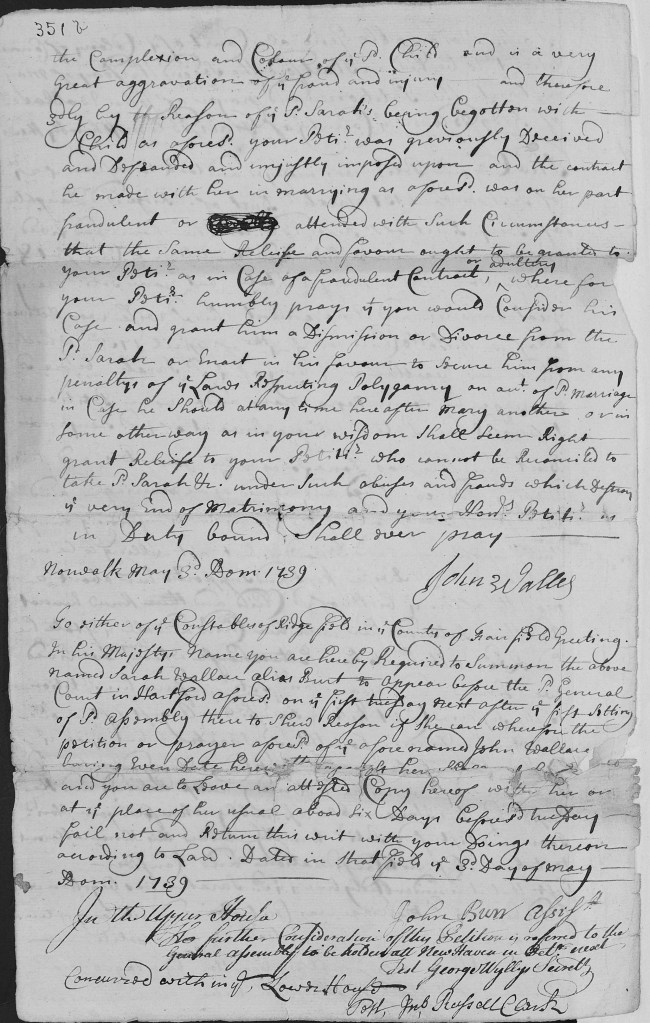
A note attached to John’s petition shows John Burr, Assistant, on the same day, at Stratfield, instructed either of the Ridgefield constables to summon “Sarah Wallis alias Burt” to appear at the General Court in Hartford “ye first tuesday Next after ye first setting of Sd Assembly” if she can show reason why the “petition or prayer” should be refused. Constable Samuel Olmsted served Sarah with the summons this time.
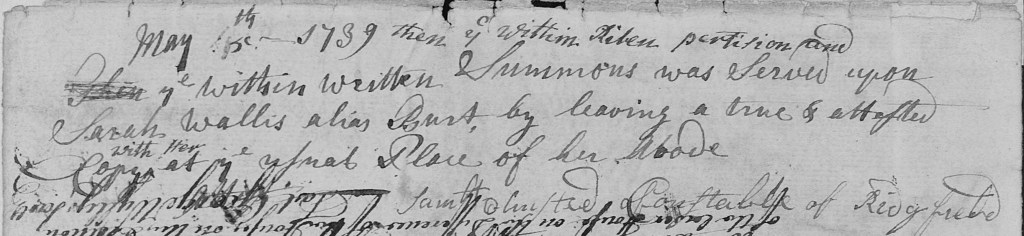
There is no record (at least available to me at this time) of Sarah appearing in person at the General Court. However, John Wallis’s petition led to further depositions at Inferior Courts held in Ridgefield that month, and Sarah did testify there. She also arranged for several experts to conduct a physical examination of her child and provide their opinions.
Fairfield County Justices of Peace Ebenezer Smith and James Benedict received depositions from supporters of John Wallis on May 7, 1739.
James Wallis Jr. and Thomas Wallis (John’s brothers) testified that John Wallis and Sarah Burt married on September 24, 1737. Hannah Sherwood and Ruth Sherwood Jr. testified they were present at the marriage, which was performed by the Revd. Mr. Hauley, now deceased, in the usual way. James Wallis Jr. and his wife Abigail Wallis (Sarah’s sister) testified they were present at the house of John Wallis when the child was born on April 4, 1738.
Vivus Dauchy (husband of Rachel Wallis, sister to John Wallis and James Wallis Jr.), James Northrup, Daniel Sherwood, Thomas Hyatt (brother to Mary Hyatt Wallis and uncle to John Wallis), and Sarah Smith, wife of Ebenezer Smith, all testified that they believed the child to be “a mallotto Child” and not the child of a white man. More specifically, Northrup said that when he saw the child “a little time after” it was born at the house of John Wallis, “upon ye first Sight was much Surprisd, and thought it look’t not as Children usually do, And Could not think it to be ye Child of ye Sd John Wallis, nor ye Child of any white man.” Daniel Sherwood said even if he had been in “Any other town, And had not known Any thing of Sd Child,” his opinion would be that the child is “mallotto.” Sherwood complained he had wanted to see the child again that day to confirm his opinion “but was not Allowed.”
Justice of Peace James Benedict received depositions from Sarah Burt Wallis and her supporters on May 12, 1739.
Sarah Wallis and her sister Thankful Burt disputed John Wallis’s claim that “he knew her not” during the month after the child’s birth, before he returned Sarah and the child to the Burt home. Thankful Burt testified “She was at ye house of John Wallis tending or nursing her sister, that She Saw John Wallis in ye Naked Bed with his wife ye nights following ye 18th & 19th of April 1738.”
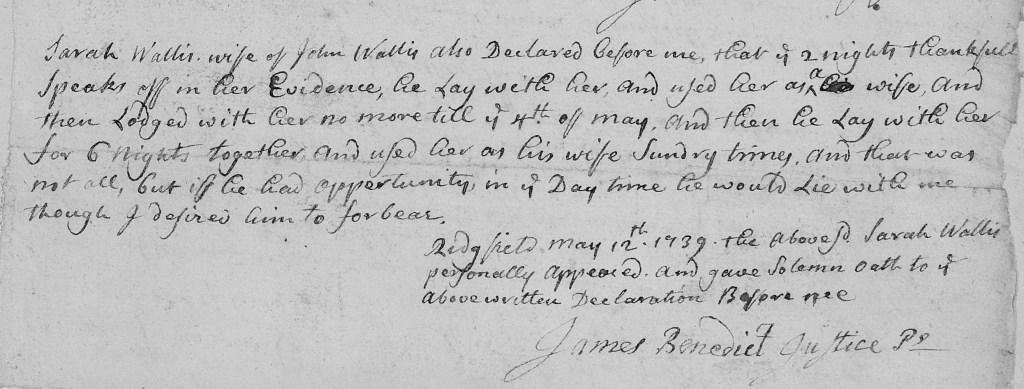
Sarah Wallis stated that John Wallis “Lay with her, and used her as a wife” not only on the two nights mentioned by Thankful but six additional nights too, and even “in ye Day time,” which she did not welcome.
Joshua Lobdell Sr. testified, his wife Eunice agreeing, that “ye Common talk in ye Town was that She was bigg by John Wallis before marriage, And that was ye Cause of their marrying So Quick.” Lobdell’s testimony was reiterated by his son Samuel Lobdell, David Osburn, and Thomas Smith Jr. These witnesses, along with Elisabeth Smith, wife of Samuel Smith, described the child’s appearance in terms of skin colour and hair texture in an affirmation of Whiteness. For example, in Samuel Lobdell’s words, he “thinks according to his observation it is whiter rather than Blacker then it was” and that “ye hair of ye Child is not like negroes hair to feel on, not harsh but soft, nor Curld like negroes hair.”
Following John Wallis’s petition to the General Court, Sarah Burt Wallis sought out the expertise of Jean Harpin, John Copp (married to Ruth Hayes Belden, widow of Sarah’s great-uncle John Belden), and Isaac Brown, described as “Practioners in Physick” in their May 10, 1739 deposition before Norwalk Justice of Peace Samuel Hanford. Sarah had brought the petition to these doctors, and asked them “to View the Child and Give their Opinion Whether the Child in their Judgements was begotten by a Negroe as is Aledg’d against her.” Having had Sarah undress the child and “Viewed the Naked Body & all the parts of it,” their opinion was that “theres Nothing appears But that the sd John Wallis or Some Other White Person May be the Father of sd Child, it not haveing the Visognomy of Negroes nor Shapes nor Limbs & Nor ye Appearance of Any Ethiopian Bloud in it.”
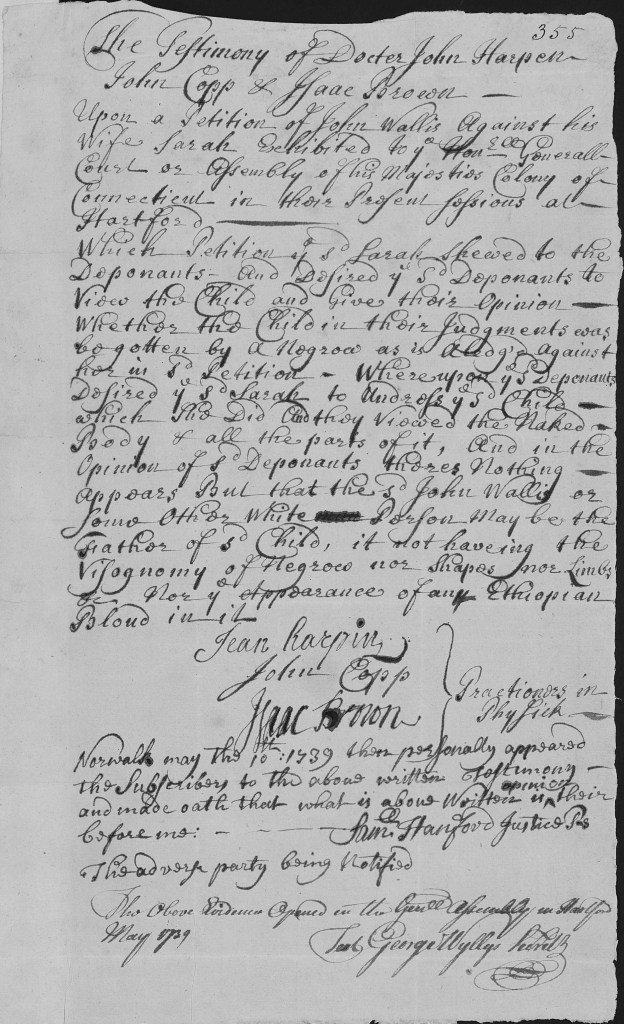
Noted at the bottom is that Justice of Peace Hanford notified the “adverse party” (i.e., John Wallis) of the deposition.
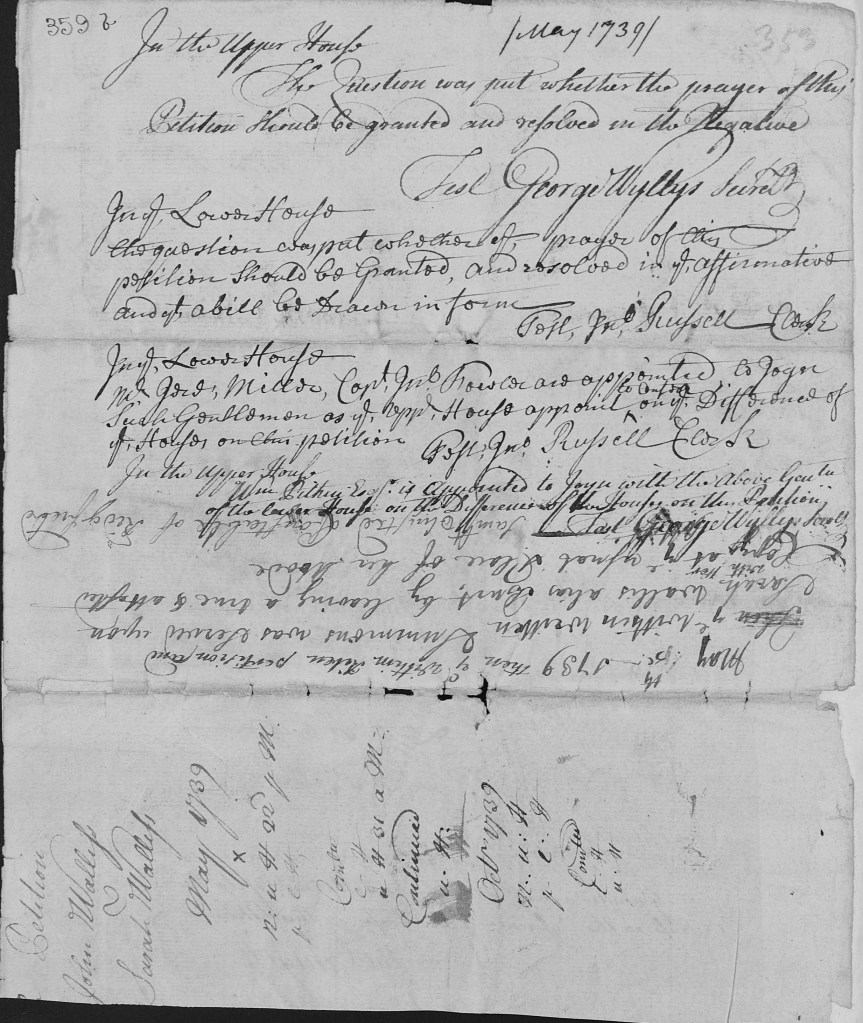
The depositions made by Sarah Burt, the trio of experts she consulted, and the townspeople of Ridgefield following John Wallis’s second petition were opened in the General Assembly in Hartford in May 1739. The General Court file also included the August 1738 decision at Fairfield by the Superior Court and depositions made earlier that same month concerning John’s first petition. The Lower House and Upper House at the General Assembly in Hartford disagreed on whether or not to grant “the prayer of this petition”: the Lower House voted “in ye affirmative,” and the Upper House “resolved in the Negative.” Members of both houses struck a committee to try to resolve their differences and agreed to revisit the petition at the General Assembly at New Haven that October.
However, at the General Assembly in New Haven in October 1739, the Lower House and Upper House voted the same way they had voted in May.
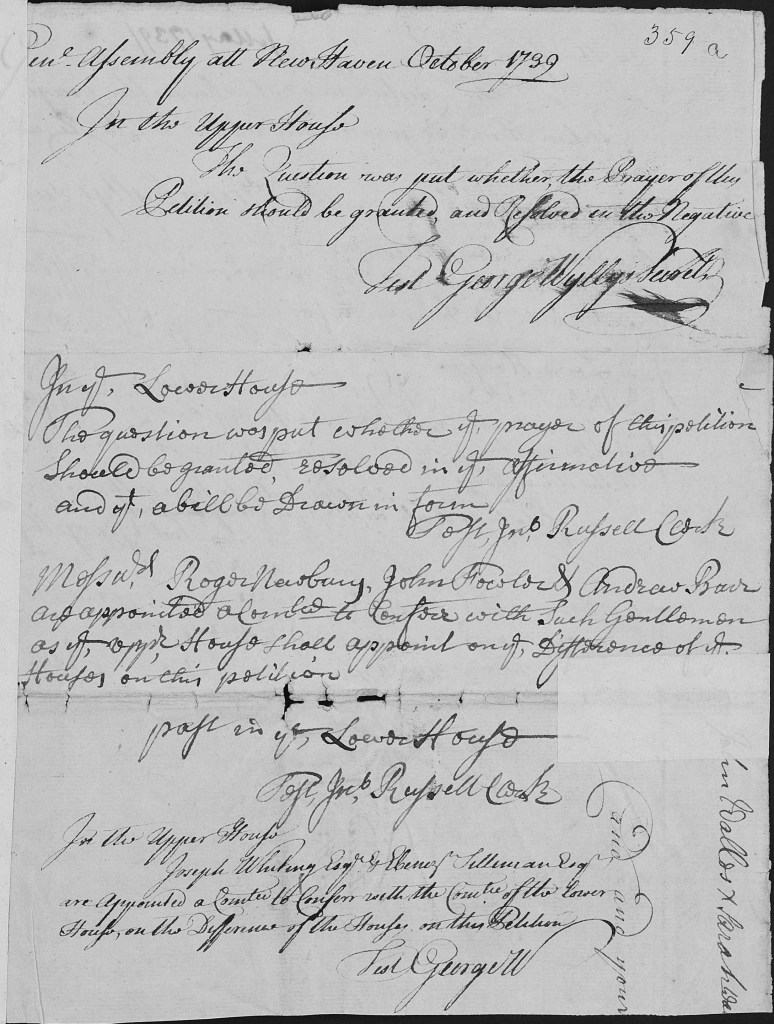
A conference committee was again struck, but it seems the differences between Houses could not be bridged, as John Wallis filed a third petition for divorce three months later.
John Wallis petitions the Superior Court, again
John Wallis’s third petition for divorce was successful. This final petition by Wallis, dated January 23, 1739/40, was again addressed to the Superior Court, this one to be held in Fairfield “on ye Last tuesday Save one in February next.”
In the petition, Wallis wrote that he “made suit” to Sarah Burt of Ridgefield during May 1737, with Sarah’s agreement and the consent of her father, Benjamin Burt, and subsequently, they agreed to enter into a “Marryed Relation.” Given this commitment, Wallis added, he “Supposed and Depended yt ye Sd Sarah who was by their personal and private agreement & contract betrothed to him would have been true and faithful to him rejected all others and with yt Confidence and Dependance in her Did on ye 24th Day of September 1737 take her to Wife in ye Covenant of Matrimony.”
John Wallis claimed that when he first saw the child born April 4, 1738, “he did not suspect to be any other than his own but a little after he was filled with Surprize fears Doubts and uncertainty whose it was and what ye Event would be till about a month after ye birth of Sd Child when he was fully Convinced that ye Same was begotton by Some Negro or Molatto man and thereupon forthwith being undeceived Returned her and all yt portion he Recd with her to her fathers house.”
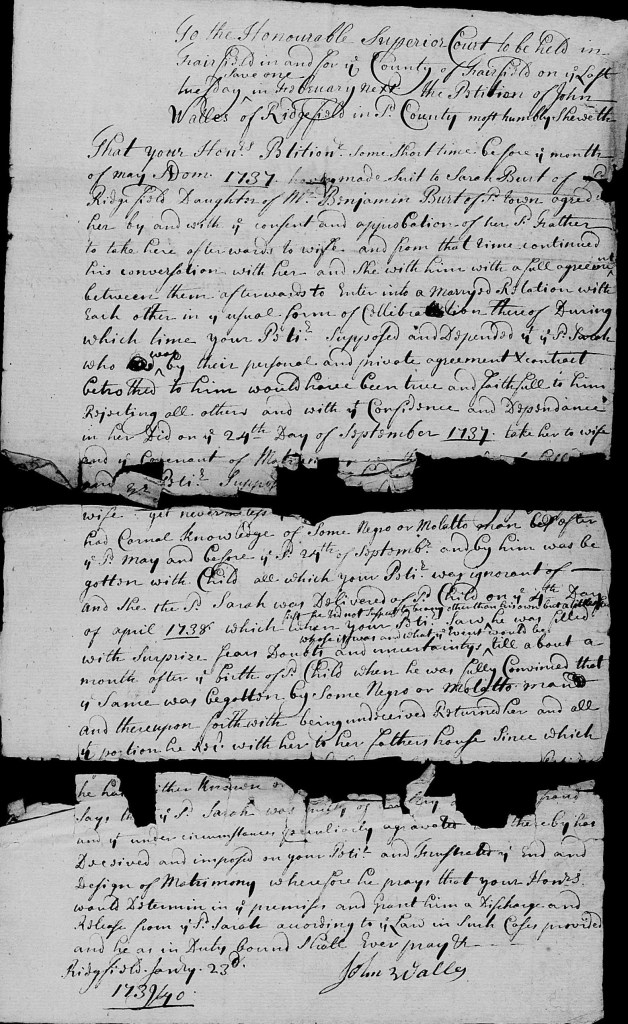
On February 7, 1739/40, Ridgefield constable Samuel Olmsted once again summoned Sarah Burt to appear in court.
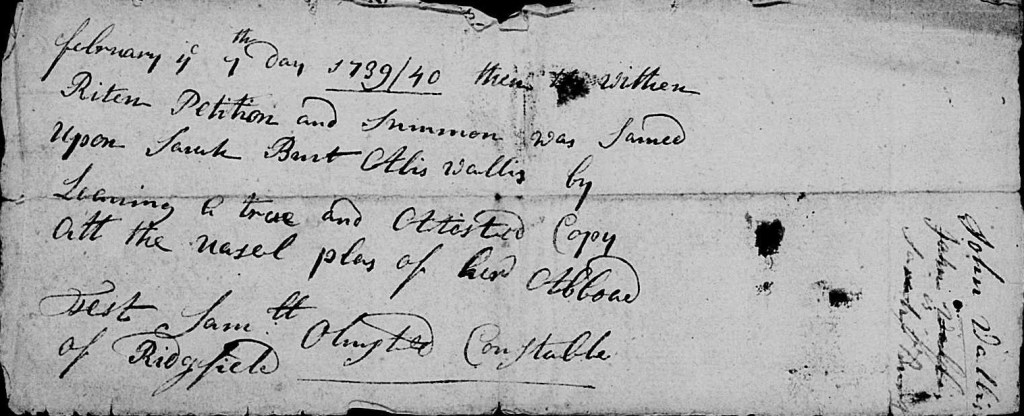
And once again, sworn affidavits followed from the townspeople of Ridgefield, some supporting John Wallis and some supporting Sarah Burt.
Townspeople who supported John Wallis testified as to the couple’s commitment to marry, and by implication thereby, John’s expectation, as recorded in his second petition for divorce, that “Sarah who was by their personal and private agreement & contract betrothed to him would have been true and faithful to him rejected all others.”
In the words of James Wallis Jr., John’s brother, “John Wallis did keep Company in a Constant way with Sarah Burt . . . as Near as I Could Observe for ye Space of Almost a year before he was married to her, And I did Conclude, and was Satisfied in my mind that his intent in keeping her Company So much as he did, was with a Design to marry her.” Vivus Dauchy and wife Rachel (sister to John Wallis and James Wallis Jr.) and Thomas Smith Jr. and Richard Olmstead Jr. provided similar testimonies, the duration of courtship respectively reported as “10 months before they were married” and “at Least, or near upon half a year . . . before ye Child was begotten.”
That the couple had made a “personal and private agreement” was substantiated by Abigail Wallis, Sarah’s sister and John’s sister-in-law, who testified “She heard ye Sarah Wallis Say, About 10 months before their marriage, John told her that if She would be true to him, and keep no other Mans Company, he would be true to her, and keep no other Girls Company, which I perceived Seemed to be very Agreeable to her.”
Others testified that Sarah’s parents were aware of the couple’s plans. Agnes Benedict, wife of Peter Benedict (son of James Benedict and Sarah Hyatt Benedict and cousin to John Wallis), said she heard Sarah’s mother say about 10 months before the child was born “that She Supposed John Wallis and her Daughter would be married as Soon as he could get a house fitt to live in.” Abigail Sherwood reported, “And I being at ye house of Mr. Burts on a Certain Day, I asked Sarah if John had asked Consent. She gave me to understand he had, I gave her to understand if it had been my Case he should not, She Said if he had not, her father would not get her things.” Lt. Ebenezer Smith, Esq. testified that he ran into Benjamin Burt getting Sarah such things at Mr. Ralph Isaac’s shop in Norwalk in late May or early June 1737. Burt said that “his Daughter were going to have a Likely Man,” they were there “in order to fitt out” Sarah “with things necessary to keep house.”
Townspeople who supported Sarah Burt testified as to her good character and insisted that only in the case of John Wallis had she strayed from virtue.
Said Lt. Richard Olmsted, “I never knew, or heard, but that ye Said Sarah Wallis was as Civil and honest a person as any body in ye whole town, Save in ye Cause of John Wallis.” Said Ebenezer Lobdell (brother-in-law to Sarah’s brother Seaborn Burt, who married Susannah Lobdell), “the “Carriage of ye woman, I never knew, or heard but it was virtuous and Commendable, Saving in ye Case of John Wallis.” Said Ebenezer Brooks (cousin to Sarah’s father, Benjamin Burt, and brother-in-law to Sarah’s mother, Sarah Belden Burt), “I never heard any report of any bad, or light Carriage of ye Said Sarah Wallis in any respect — except in the case of John Wallis.”
Making similar statements as to Sarah’s “carriage” or agreeing in full with the statements made by others were Mary Olmsted, Lt. Richard Olmsted’s wife; Rachel Benedict; Martha Smith; Elizabeth (Belden) Brooks, Ebenezer Brooks’ wife (aunt to Sarah, sister to Sarah’s mother, Sarah Belden Burt); Joshua Lobdell and wife; Lemuel Morehouse and wife; Christopher Burt (Sarah’s eldest brother) and wife (Joanna Saint John); Mr. Richard Osburn; Samuel Lobdell; and David Osburn.
On August 19, 1740, the Fairfield Superior Court issued a continuance in the case.

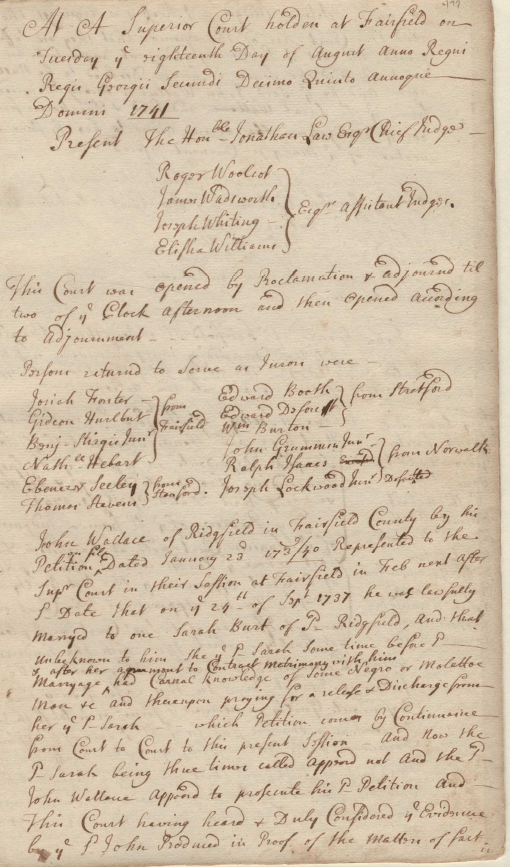
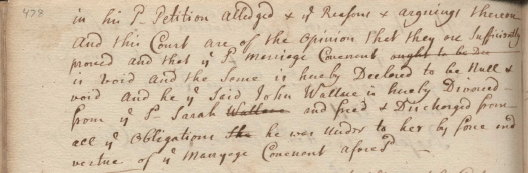
A year later, on August 18, 1741, the Fairfield Superior Court granted John Wallis of Ridgefield the divorce he had long sought. Sarah Burt, also of Ridgefield, had been called three times to court, and had not appeared.
Mamanasco hill: next generation
As children of Ridgefield’s first generation of proprietors, Sarah Burt and John Wallis were part of the town’s next generation. Benjamin Burt and James Wallis, their fathers, were not among the original proprietors, however.
In May 1708, Connecticut’s General Assembly at Hartford granted permission to a group of townsmen from Norwalk to purchase land from “the Indians” that would be bounded on the north and northeast by Danbury, the south by Norwalk, and the west by the boundary with New York, “to ye End they might make a plantation there and settle upon the same.” On September 30, 1708, a deed was signed by “Catoonah Sachem of Ramapoo Indians, and Associates” granting an estimated 20,000 acres for a price of 100 pounds.
In November 1708, a committee was chosen to lay out Ridgefield’s town plot, with home lots of 7.5 acres each (allowing adjustments for quality), assigned by draw. Originally, there were 24 proprietors, mostly from Norwalk, with a few from Milford. There were 25 lots laid out: one was designated “The proprietors Reserve.”
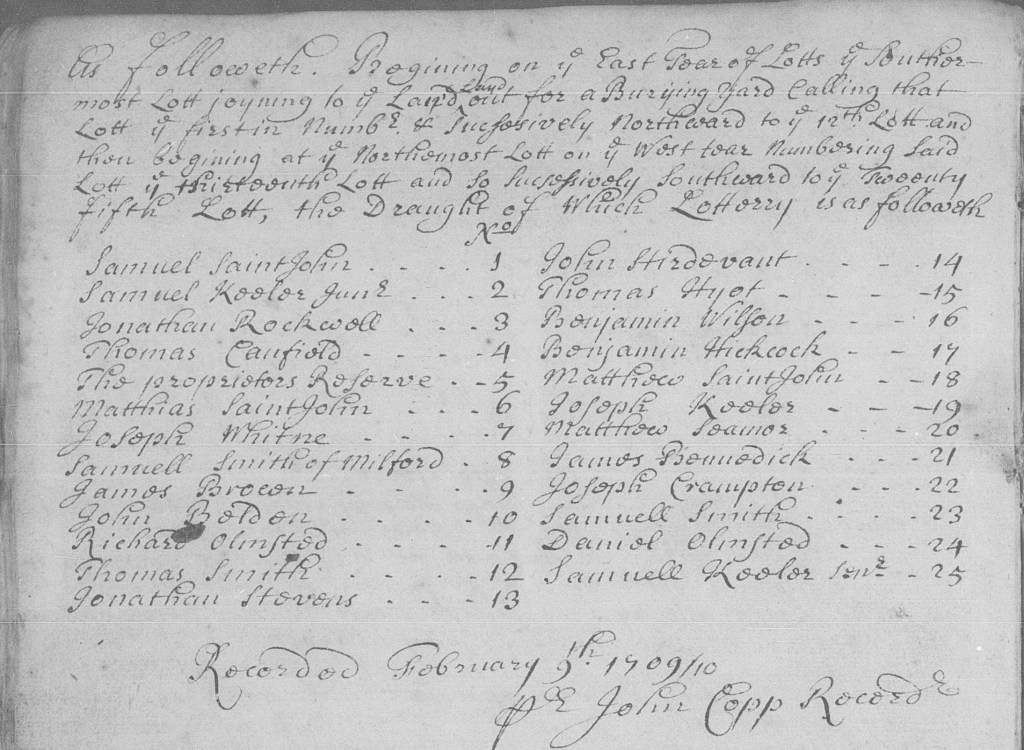
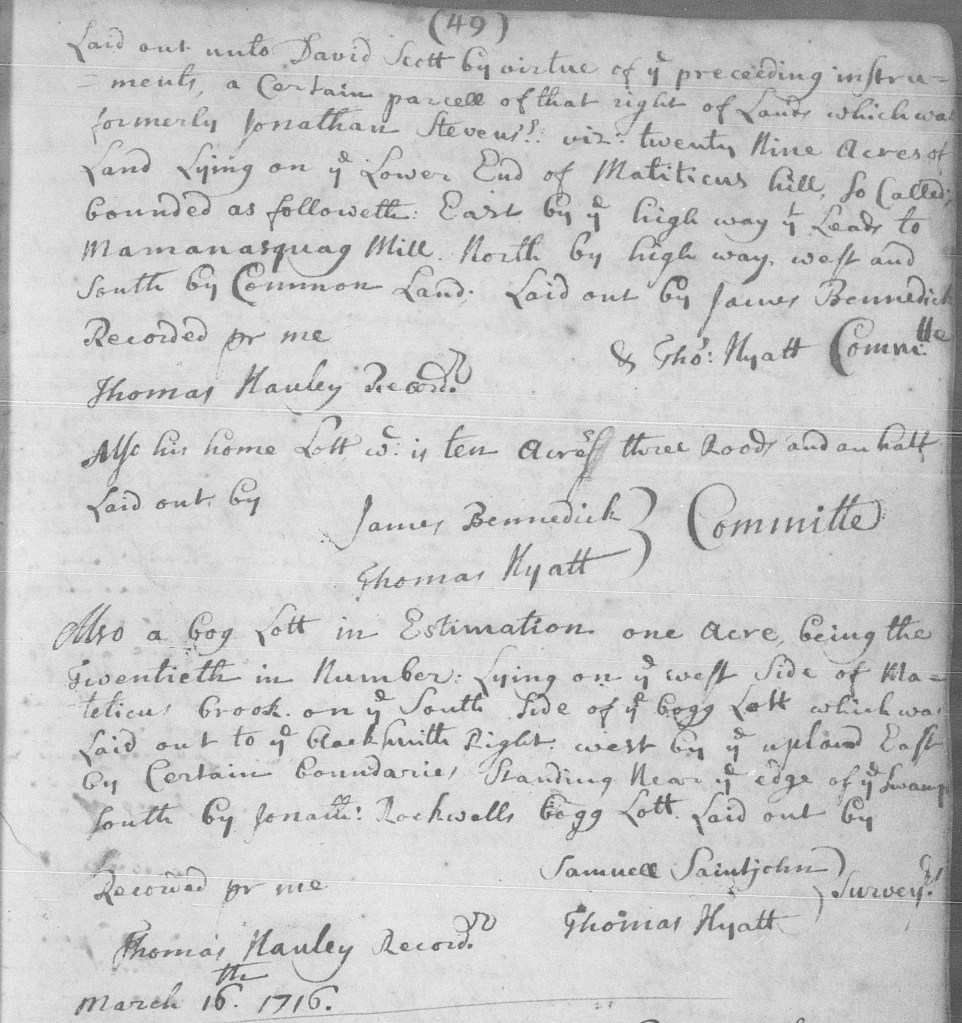
The proprietors had equal right to further divisions of land, with draws for plow land, meadow land, pasture land, boggy meadow, and upland held subsequently. In March 1709, when meadow land lots were laid out, there were 25 proprietors, Ebenezer Smith having been added, with a 26th lot reserved to the proprietors. By the “Boggy Meadow division,” in January 1709/10, there were 26 proprietors, Joseph Benedict having been added, with a 27th lot reserved to the proprietors and a 28th lot for the “Black Smiths Right.”
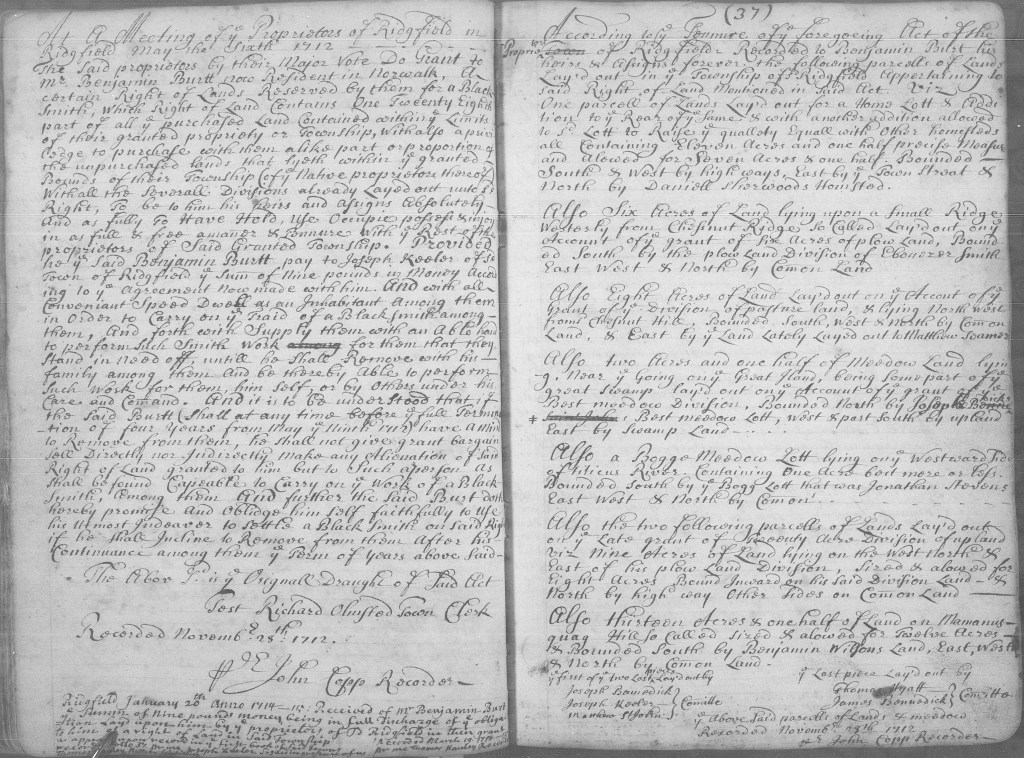
Benjamin Burt, Sarah’s father, took up the “Black Smiths Right.” On May 6, 1712, Ridgefield’s proprietors voted the 1/28th right set aside for a blacksmith to be granted to Benjamin Burt; he was to pay nine pounds. The lands laid out to him were recorded.
The proprietors reserve had been set aside for a minister, and on January 20, 1714/15, the proprietors voted to grant this “one full twenty Eighth part of ye whole ProprietyShip” to their present minister, Mr. Thomas Hauley.
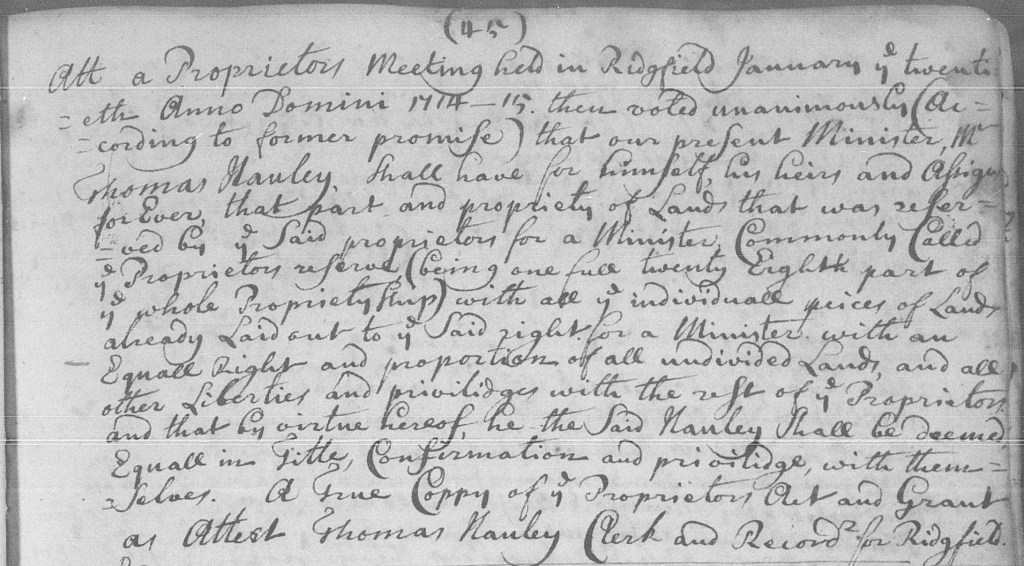
This made for 28 proprietors in total.
On February 24, 1714/15, the proprietors voted to admit James Wallis, now of Ridgefield, as a proprietor going forward. The proprietors were on the verge of acquiring a new tract of land from “Tackora, Alias Oreneca, Indian.” Wallis was to make an equal contribution to the purchase cost in return for a full proprietor right in the new tract.
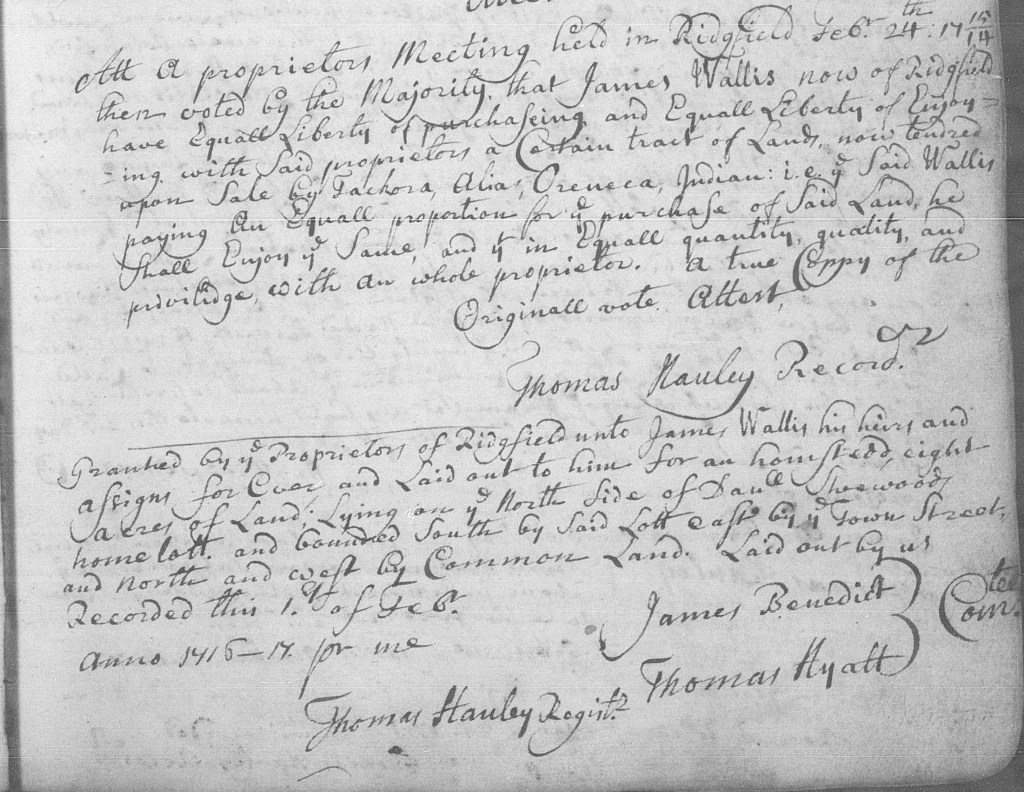
James Wallis was brother-in-law to two of the original proprietors: Thomas Hyatt was Mary Hyatt Wallis’s brother, and James Benedict’s wife, Sarah Hyatt Benedict, was Mary Hyatt Wallis’s sister. James Wallis was born in Scotland and had been pressed into service in the Royal Navy, but when anchored in Long Island Sound, around 1705, he managed to jump ship and swim ashore to Norwalk, where he wooed and wed Mary Hyatt, daughter of Thomas Hyatt and Mary Saint John.
The tract of land obtained from Tackora alias Oreneca is referred to as “the new purchase” in the Ridgefield land records. Tackora alias Oreneca is described in the deed, dated March 18, 1715 [1714/15], as “one of ye Native proprietors and owners of these tracts of unpurchased lands, Lying above Ridgefield in ye County of Fairfield, and Colony of Connecticutt in New England.” There is an additional signature from Ocomoywa’, but he is not mentioned in the deed itself; rather the tract is characterized as “belonging unto me ye Said Oreneca.” The proprietors paid four pounds.
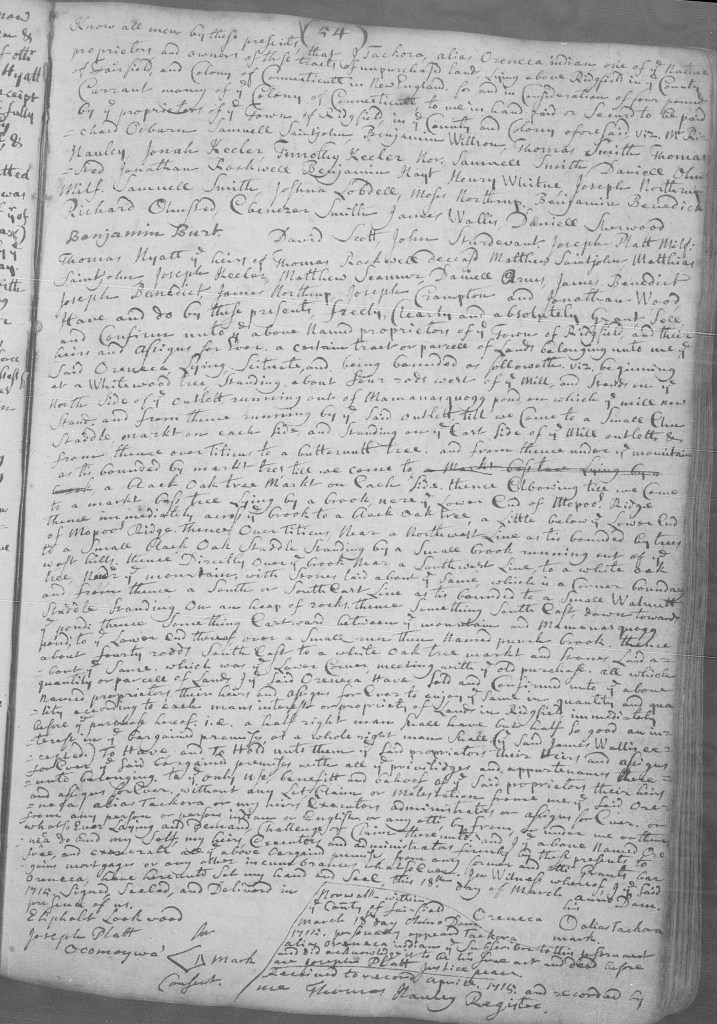
The northwest corner of the original purchase was marked by an oak tree lying on the north side of the outlet of water coming out from “a sort of a grassy pond” called Mamanusquag pond. In the Ridgefield land records, the spelling of this Indigenous name varies: for example, “Mamanasquogg,” “Mamanasquog,” “Mamanusquaw,” “Mamanasqua,” “Mamanasco,” and “Mamanusco.” The boundaries of the new tract were described as beginning at Mananasquogg pond, and the 1714/15 deed mentioned that a mill “now Stands” on the pond, sitting four rods to the east of the marked tree.
So it appears there was already a mill onsite when at a meeting in November 1716, the Ridgefield proprietors voted to sequester “Mamanasquogg pond” and its outlet for the operation of a grist mill. On January 30, 1716/17, Daniel Sherwood entered a “Covenant” with the proprietors to erect “a good sufficient grist mill” on the outlet of “mamanasquog pond.” By agreeing to be miller for Ridgefield, Daniel Sherwood became the town’s 29th proprietor, his full right, unlike James Wallis’s, equal to that held by the original proprietors.
The home lots of the first generation of Ridgefield proprietors were laid out on both sides of what was then “Town Street” and is now “Main Street.” When Benjamin Burt, James Wallis, and Daniel Sherwood became proprietors, they received adjoining home lots on the west side of Town Street, to the north of lots laid out for the original proprietors: Daniel Sherwood was bounded by James Wallis on the north and Benjamin Burt on the south (Burt’s lot was bounded by a highway on the south, called then Burts Lane and now Catoonah St.). Many of the proprietors’ children, as members of the next generation, established homesteads elsewhere, including northwest of Ridgefield’s town plot on Mamanasco hill.
John Wallis and Sarah Burt Wallis seem to have been among Mamanasco hill’s early residents. In their February 19, 1739/40 depositions, Rachel Dauchy and James Benedict indicated that John and Sarah were living somewhere up from (presumably north of) the house of Benjamin Burt, Sarah’s father. Rachel Dauchy (John Wallis’s sister) said she asked Christopher Burt (Sarah’s brother) about the child, Christopher “Sometime before ye Child was brought down having been up to See ye Child.” James Benedict mentioned being at (his son) Peter Benedict’s house and speaking with John Wallis “Sometime before ye Sd Sarah was brought down to her father’s house.” When James Benedict’s daughter-in-law Agnes Benedict testified she heard Sarah Burt’s mother say “that She Supposed John Wallis and her Daughter would be married as Soon as he could get a house fitt to live in,” John was probably building the “house fitt to live in” at Mamanasco hill.
According to Ridgefield historian Jack Sanders, “Mamanasco Hill is a very old name for the ridge to the northeast of Mamanasco Lake, a ridge that includes North Salem Road, upper Pond Road, Circle Drive, Hobby Drive, and Colonial Lane.” In the 1830s, the name for the area became “Scotts Ridge.”
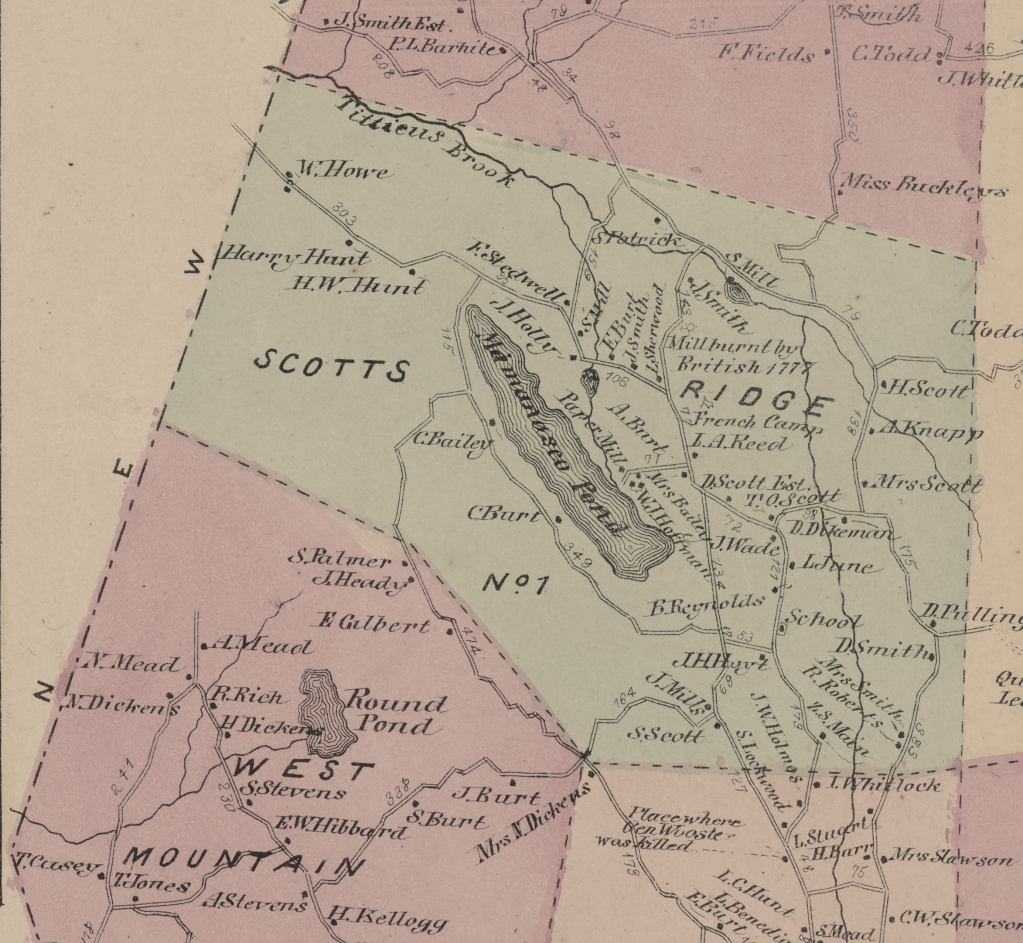
While landholders at Mamanasco hill can be readily traced through the Ridgefield land records, it is more difficult to discern which landholders established homesteads there. By 1712, Samuel Smith, late of Milford,3 Thomas Smith, Benjamin Willson, and Benjamin Burt held land at Mamanasco hill. The adjoining lots of Samuel Smith and Thomas Smith were located on the east side of the ridge. By 1721, Alexander Resseguie of Norwalk (having bought out Benjamin Willson), Joseph Keeler, James Wallis, David Scott, and Joseph Northrup were also Mamanasco hill landholders, with Joseph Keeler, James Wallis, and David Scott located below Mamanasco Pond.
In April 1734, Benjamin Burt deeded 13.5 acres on Mamanasco hill to Thomas Smith in exchange for Peter, the enslaved man in the Burt household subsequently accused of fathering Sarah’s child.
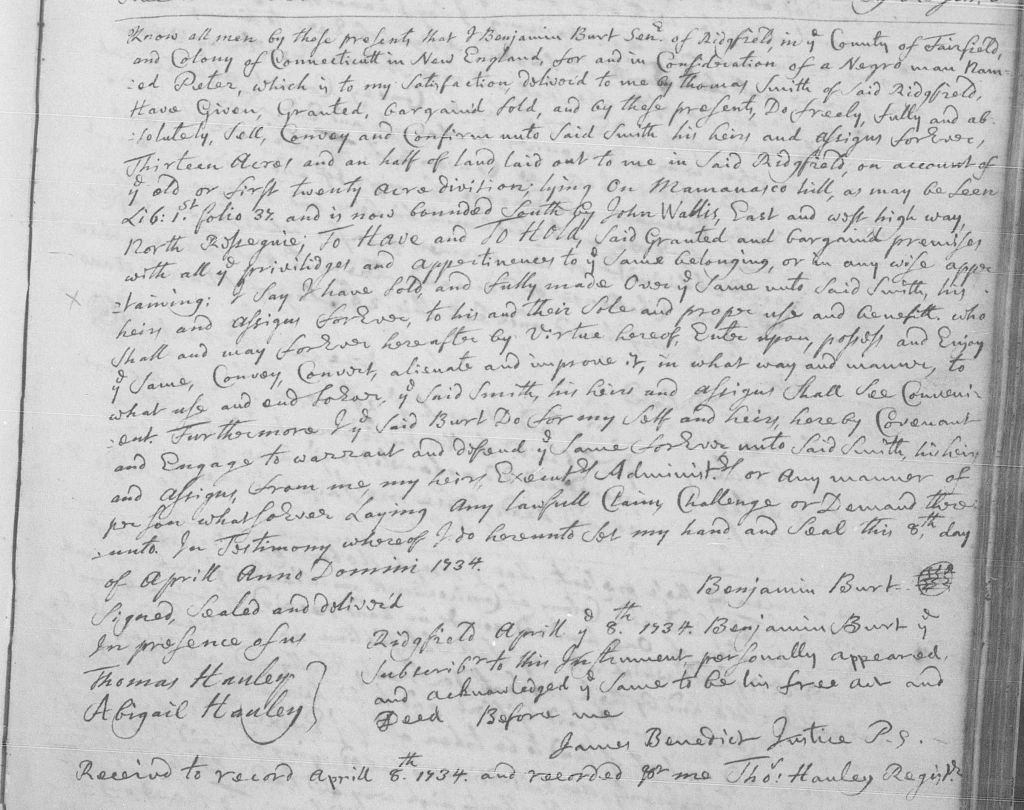
The land sold by Benjamin Burt was bounded on the north by Alexander Resseguie, on the south by John Wallis, and on the east and west by highways.
John Wallis had bought the 25 acres of land at Mamanasco, bounded north by land of Benjamin Burt, south by land of Joseph Keeler, and east and west by highways, from Alexander Resseguie, by then of Ridgefield, for 200 pounds in January 1732/33. In April 1733, John sold Vivus Dauchy a full half of the tract of land, taken off the south part, for 100 pounds. John’s sister Rachel Wallis had married Dauchy in November 1732. John’s brother James Wallis Jr. bought 12 acres of land at Mamanasco, bounded north and west by land of David Scott and south by land of Joseph Keeler, from Joseph Lee for 70 pounds in October 1735. James Wallis Jr. and Sarah’s sister Abigail Burt had married in February 1735/6. Joseph Lee had himself purchased that land from James Wallis, Sr. in November 1729.
On May 20, 1738, John Wallis signed over “all ye peices & parcells of Land which I have at a place Called Mamanusquaw in ye Township of Ridgfield” to his father, James Wallis. This occurred between his return of Sarah Burt, her dowry, and her child to the house of her father, Benjamin Burt, in early May and his filing a petition for divorce on June 26th.
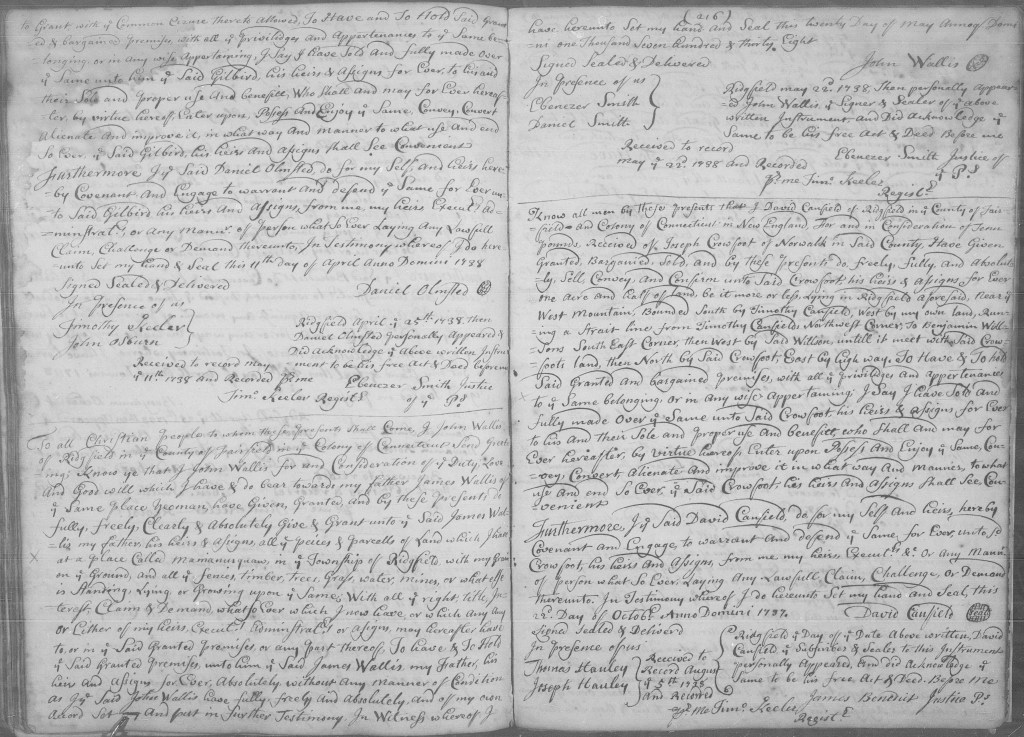
On April 14, 1742, eight months after the Fairfield Superior Court granted John Wallis a divorce, James Wallis signed all properties at Mamanasco back over to his son.
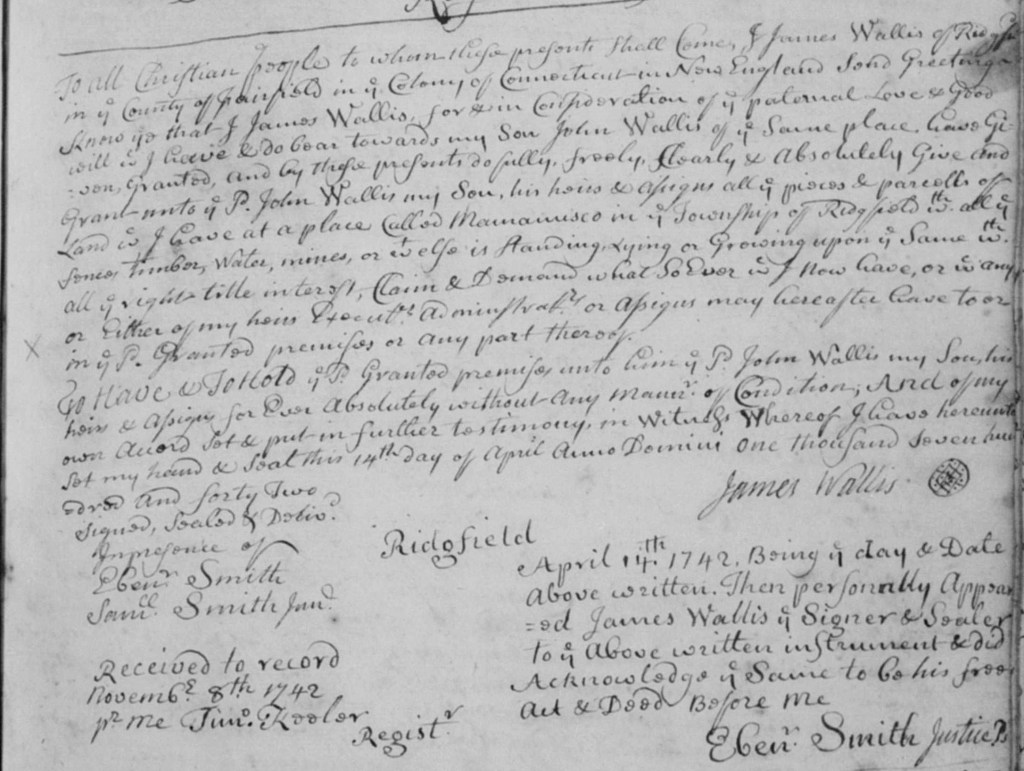
And so, this appears to be an early, 18th-century, example of a man protecting his assets during divorce proceedings.
The extent of John Wallis’s landholdings at Mamanasco during this period is unclear, as these deeds of gift between John and his father do not itemize the properties. Certainly, one property was the 12 acres and three rods on Mamanasco hill that John sold to Gideon Smith for 140 pounds on the same day that James Wallis deeded the properties back to his son. This was half the 25-acre parcel John Wallis had bought from Alexander Resseguie for 200 pounds, bounded on the north by Thomas Smith (who had bought from Benjamin Burt) and on the south by his brother-in-law Vivus Dauchy (to whom he had sold the other half). Additionally, in February 1748/49, John Wallis, by then of Salem, sold to Lemuel Morehouse, for 480 pounds, 35 acres on the east side of “Mamanasqua Pond,” bounded east by highway, north by Isaac Keeler’s land, west by highway, and south by common land; in return, also for 480 pounds, John Wallis bought from Lemuel Morehouse 31 acres in the New Purchase adjacent to The Oblong/Westchester Co.
The grist mill at the outlet of Mananasco Pond eventually ended up in the hands of the Burt family, and for a time, Mamanasco Pond was called Burts Pond. In November 1742, Benjamin Burt, Sarah’s father, exchanged lands in the New Patent (what became Ridgebury) for Joseph Keeler Jr.’s right in the mill. Interest in the mill had been transferred from Daniel Sherwood to Samuel Saint John in April 1721, from Samuel Saint John to Nathan Whitney, from Nathan Whitney to Joseph Keeler Sr. in May 1725, and from Joseph Keeler Sr. to his son Joseph Keeler Jr. in August 1741. Benjamin Burt retained his right in the mill until he died in 1759 and the right passed to his son Seaborn Burt.
Not a polygamist: John Wallis remarries and moves to Salem, New York
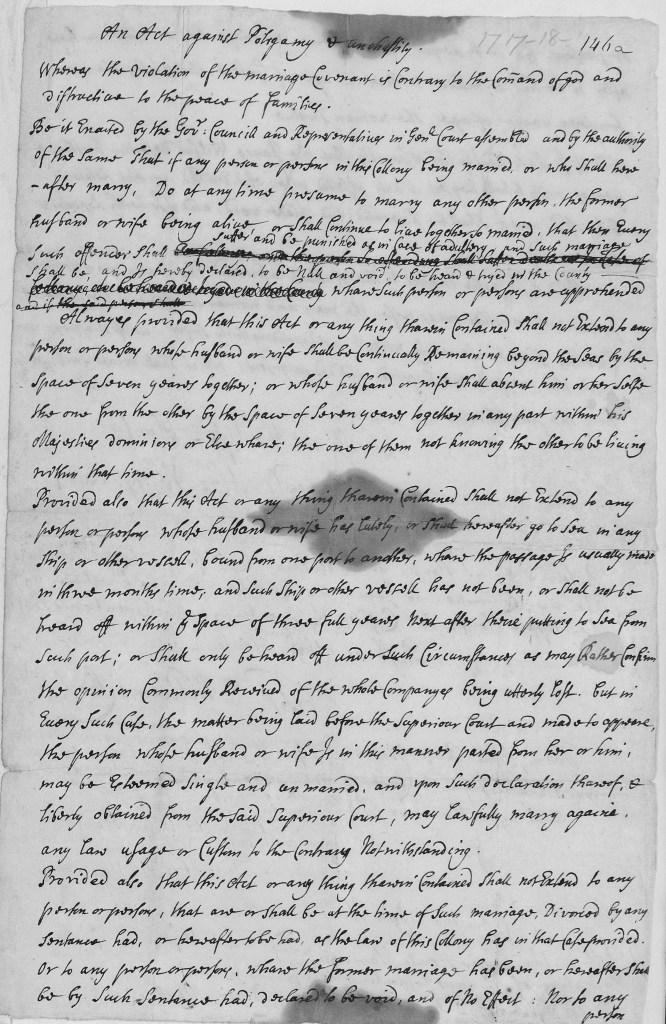
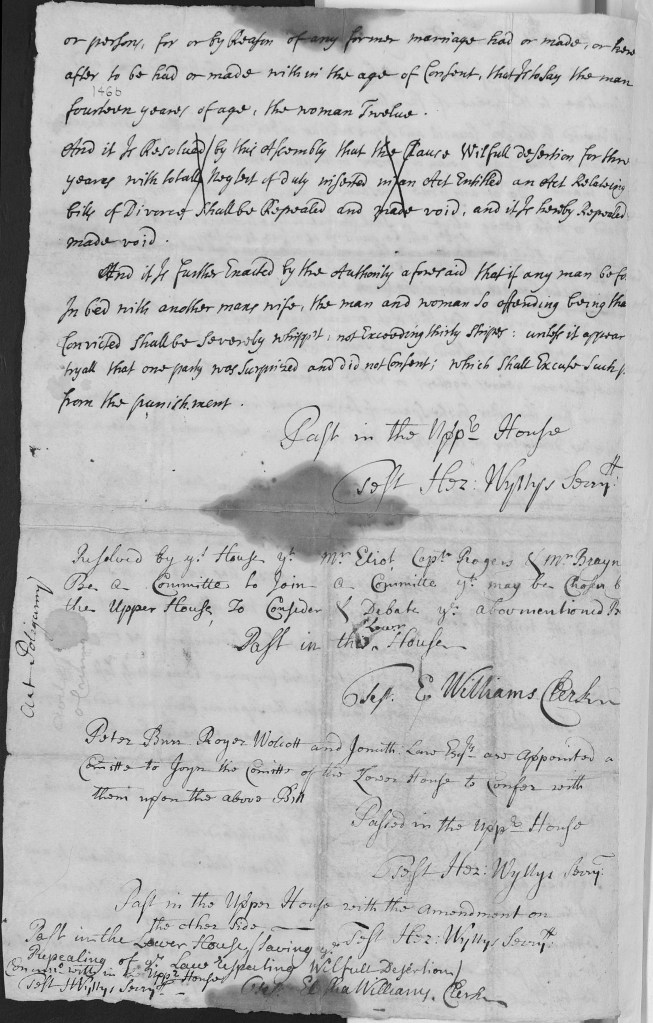
In his petition to the General Court, John Wallis said he desired a a dispensation or divorce “to secure him from any penalty of ye Laws Respecting Polygamy” should he marry another.
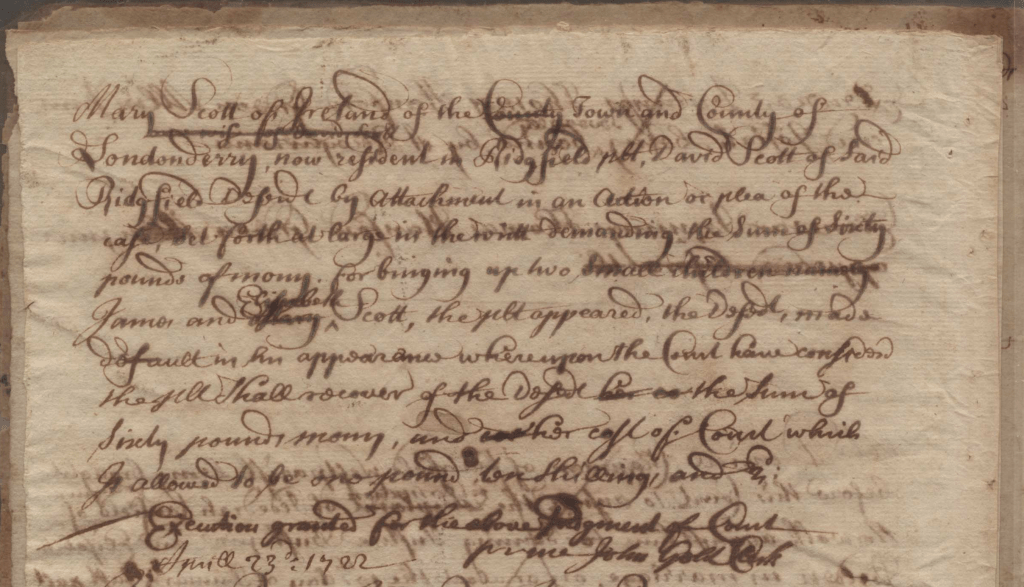
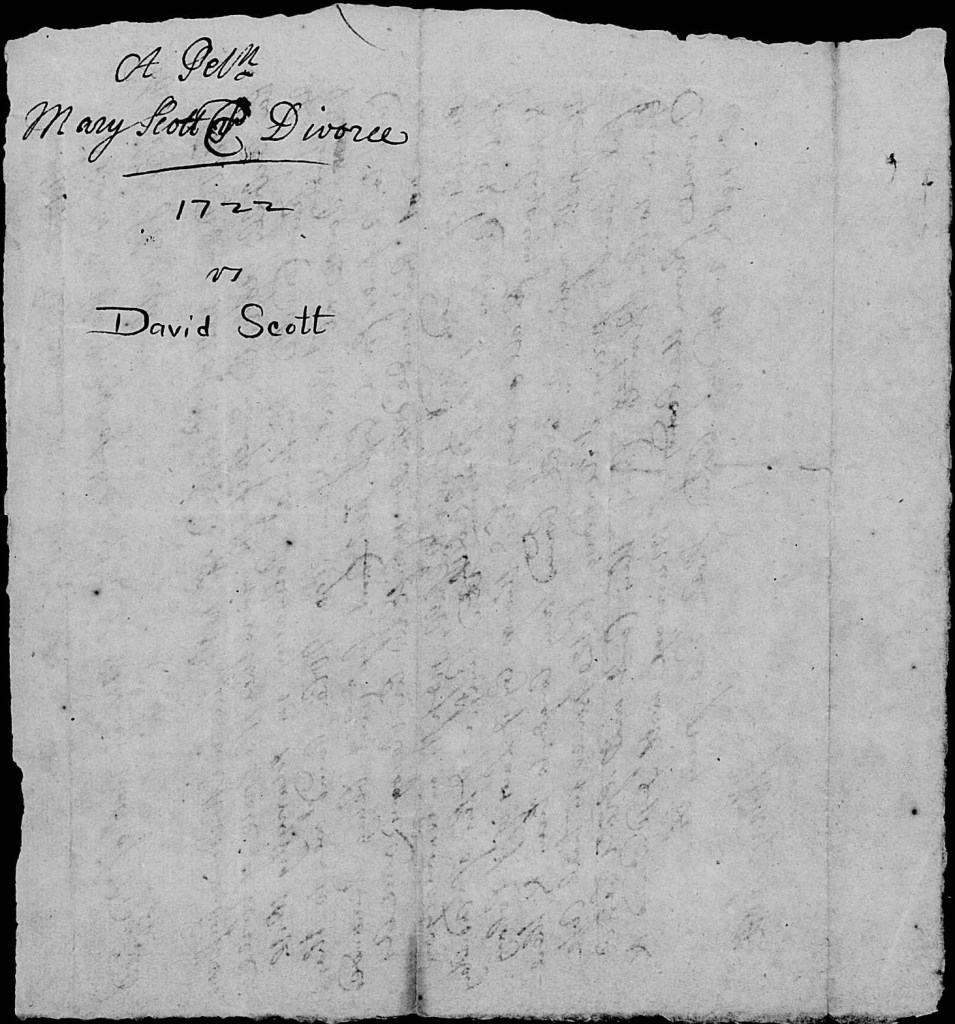
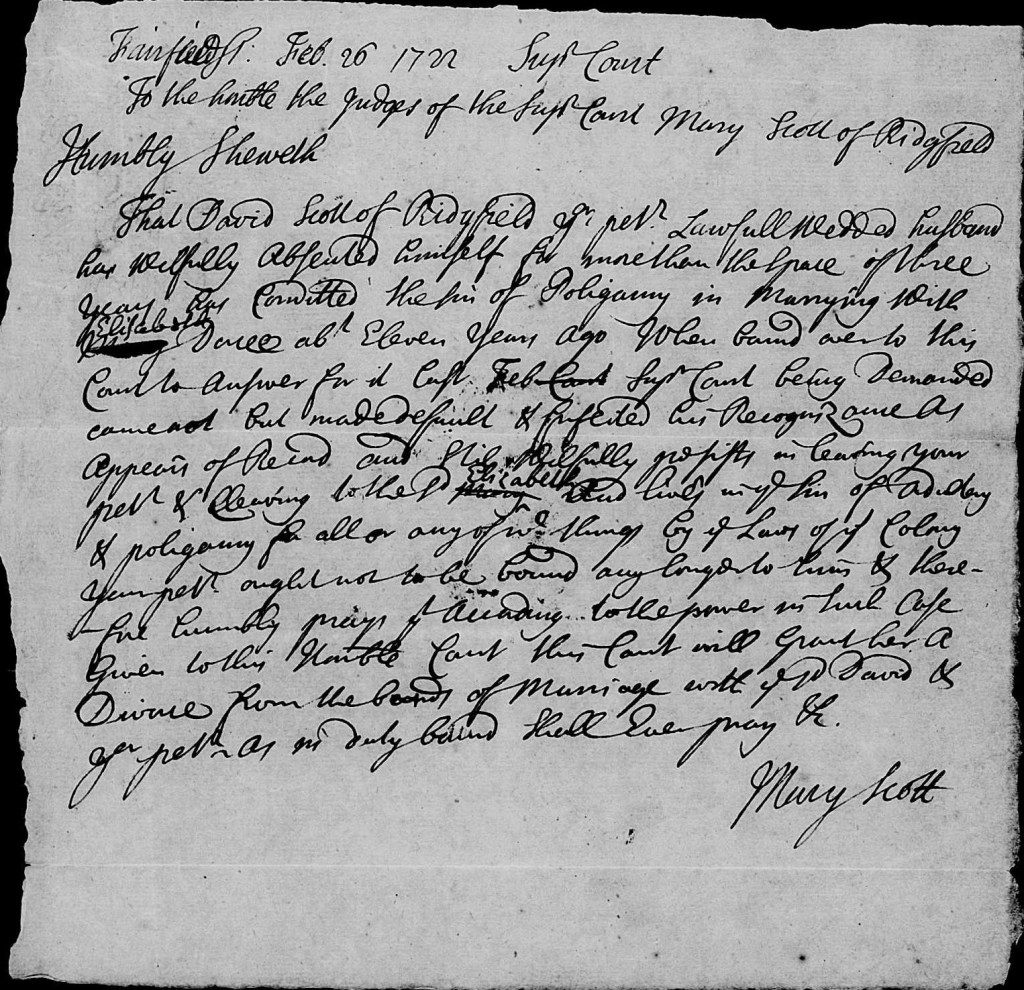
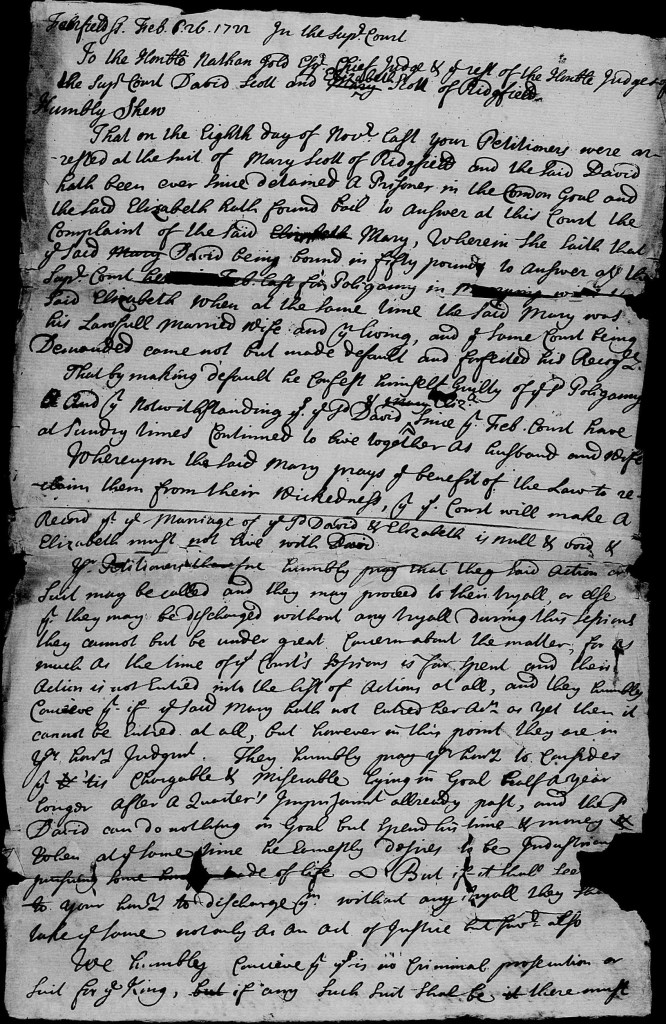
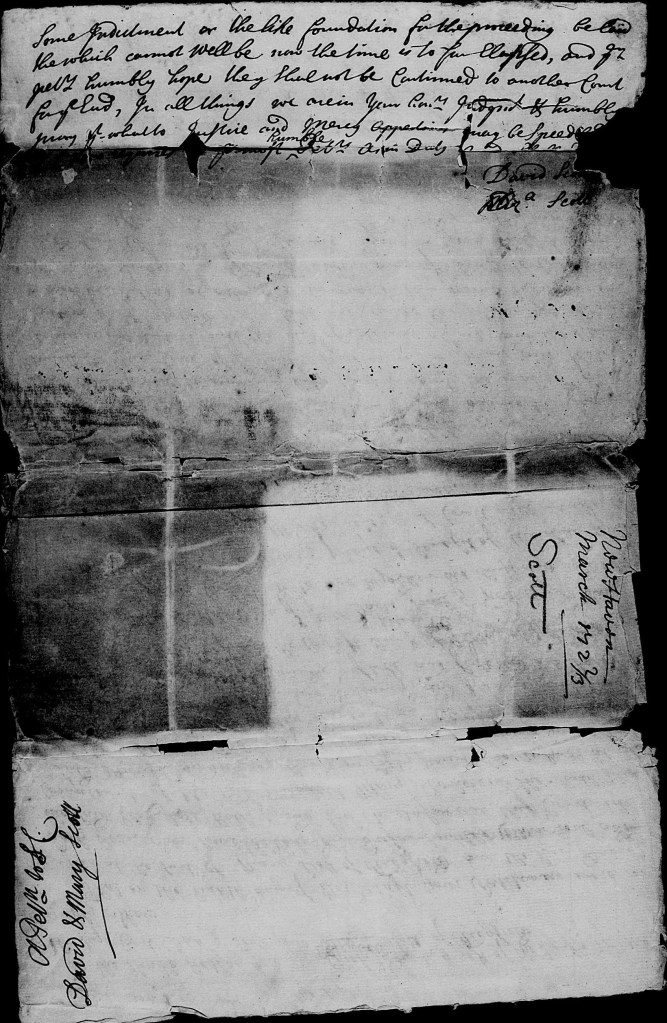
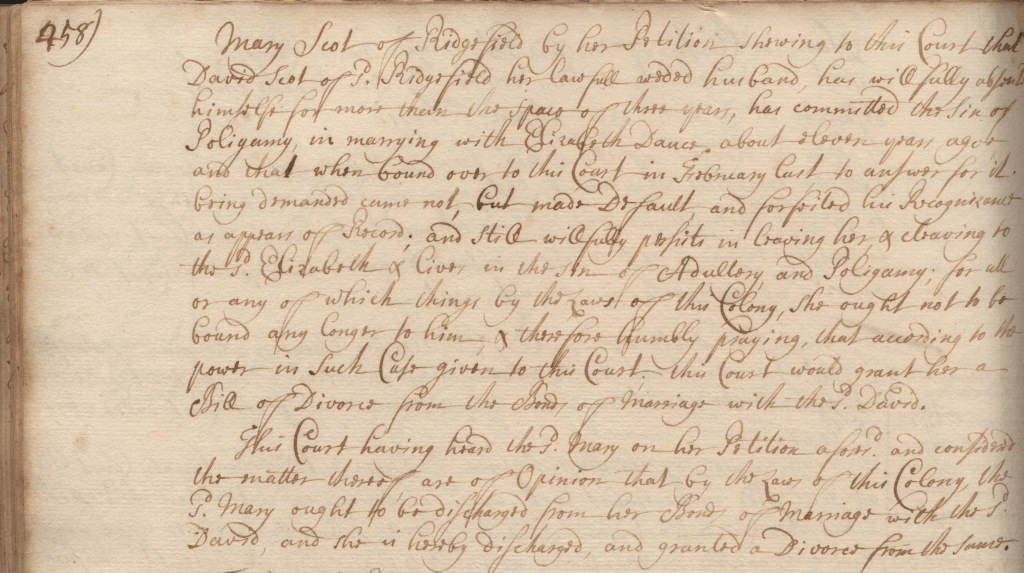
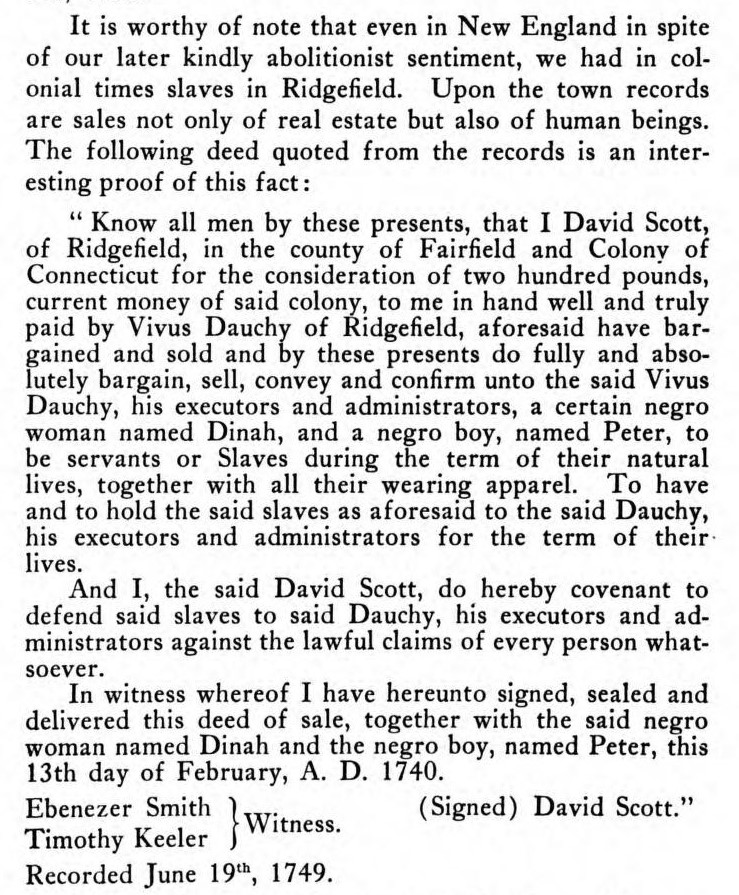
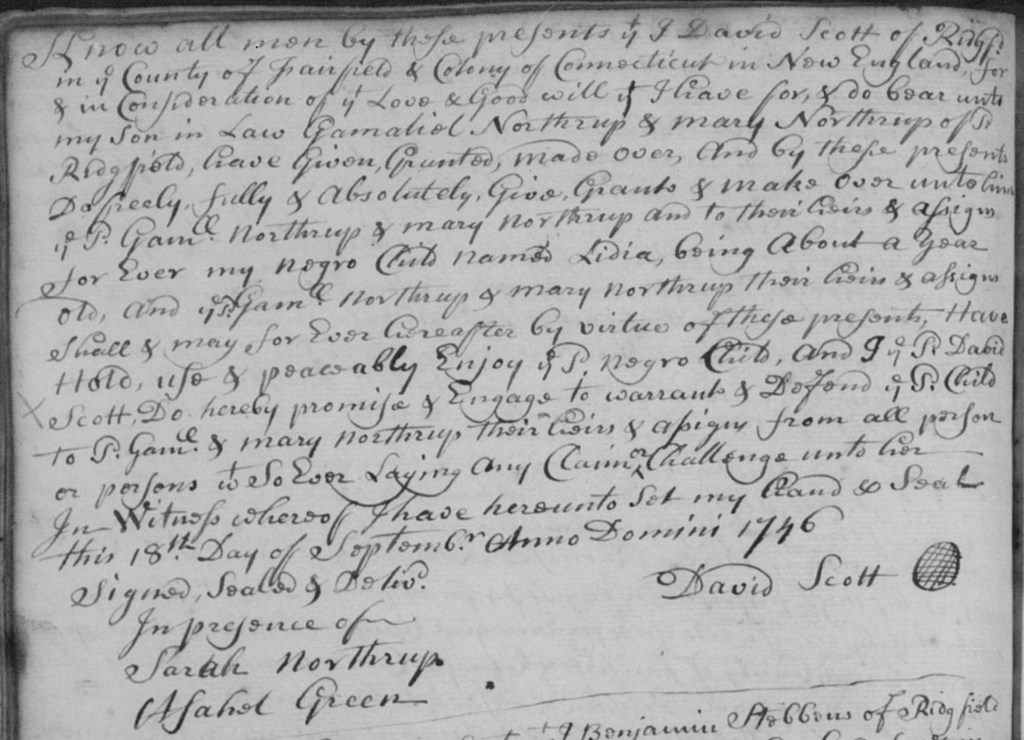
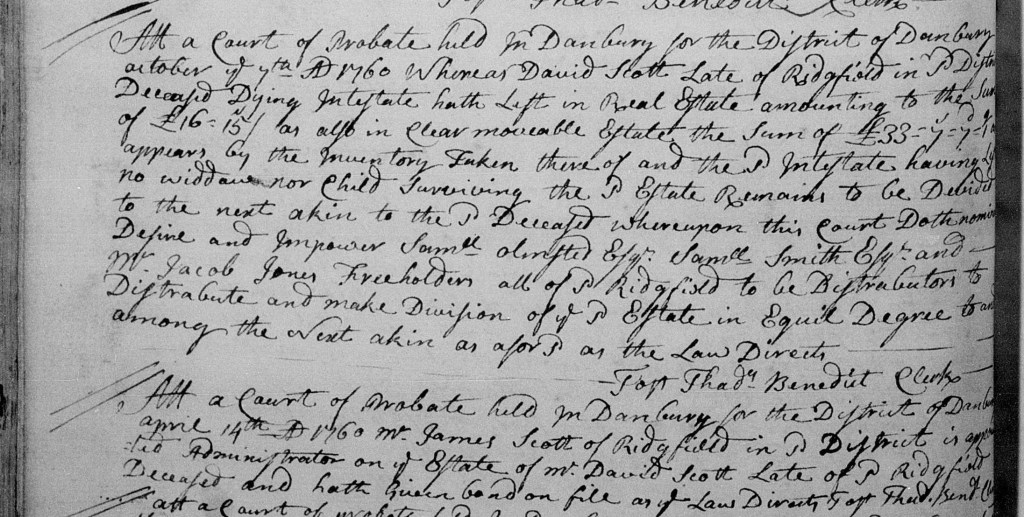
Polygamy was not theoretical as a prospect for John. Although divorce cases were not common in early 18th-century Connecticut, in 1722/23, David Scott was sued successfully for divorce by his wife Mary Scott, on the grounds he had entered into a second, polygamous, marriage and willfully deserted her for more than three years. David Scott was neighbour to the Burts and Wallises at both Mamanasco hill — presumably, Scotts Ridge is named after him — and Ridgefield’s town plot, where his home lot lay immediately south of Benjamin Burt’s across what is today Catoonah St. David Scott’s stepson, Vivus Dauchy, became brother-in-law to John Wallis, when he married John’s sister Rachel Wallis.
Fortunately, third time lucky in petitioning for divorce, John was free to remarry without worrying about becoming a polygamist. According to The Wallace Family in America, John Wallis married Martha Scofield, about 1746. They had 12 children born between 1747 and 1769, who were entered in the Ridgefield town records. In addition to the 10 children listed below, Epenetus was born in 1766 and Mary was born in 1769.
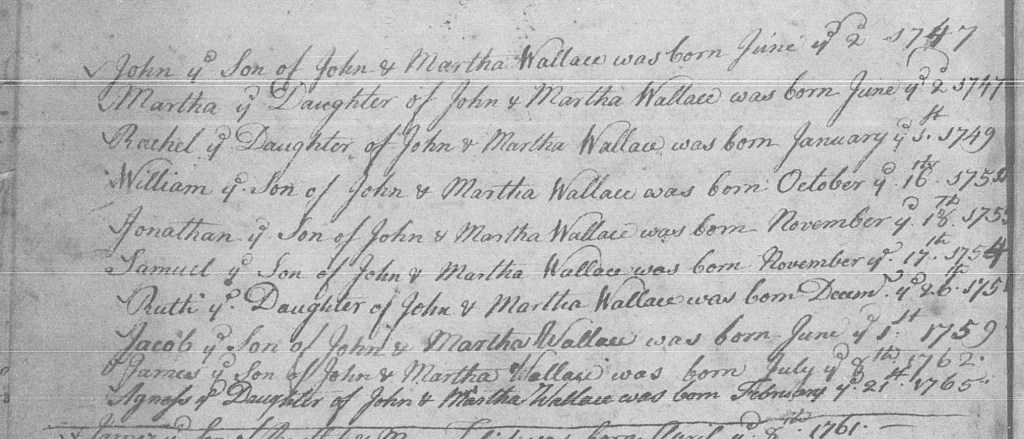
Although the children of John Wallis and Martha Scofield were entered in the Ridgefield town records, the family lived in Westchester County, New York, in an area of The Oblong that became Salem, then Upper Salem, and finally North Salem as years passed.
According to land records, by early 1739, in the midst of John’s repeated petitions for divorce, his parents, James and Mary (Hyatt) Wallis, and brother and sister-in-law James Wallis, Jr. and Abigail (Burt) Wallis had moved from Ridgefield to the Oblong. In February 1742/3, when Jabez Smith bought land from the Wallis siblings, John Wallis, Jacob Wallis, Vivus and Rachel (Wallis) Dauchy, and Daniel and Agnes (Wallis) Benedict were living in Ridgefield, while Samuel and Sarah (Wallis) Saint John, like James Wallis Jr., were living in Westchester Co., though the Saint Johns in Cortlandt Manor. Their brother Thomas Wallis had died that October. John Wallis, newly remarried, was living in the Oblong, in the Town of Salem, by February 1746/7.
“The Oblong” was an entity created due to a protracted boundary dispute between the colonies of Connecticut and New York. The Oblong land bordering Ridgefield had been claimed by the Ridgefield townspeople as theirs. Early conflicts about the Connecticut–New York boundary were between the Dutch and English. In 1650, Governor Stuyvesant and Connecticut authorities agreed on a provisional boundary that would “begin at the west side of Greenwich Bay, being about four miles from Stamford, and so run a northerly line twenty miles up into the country until it shall be notified by the two governments of the Dutch and of England, provided the said line shall not come within ten miles of the Hudson River.” The provisional Hartford treaty of 1650 was never ratified, however. The 1650 line is shown on this 1876 map representing 17th-century southern New England and New York, with later state boundaries superimposed:
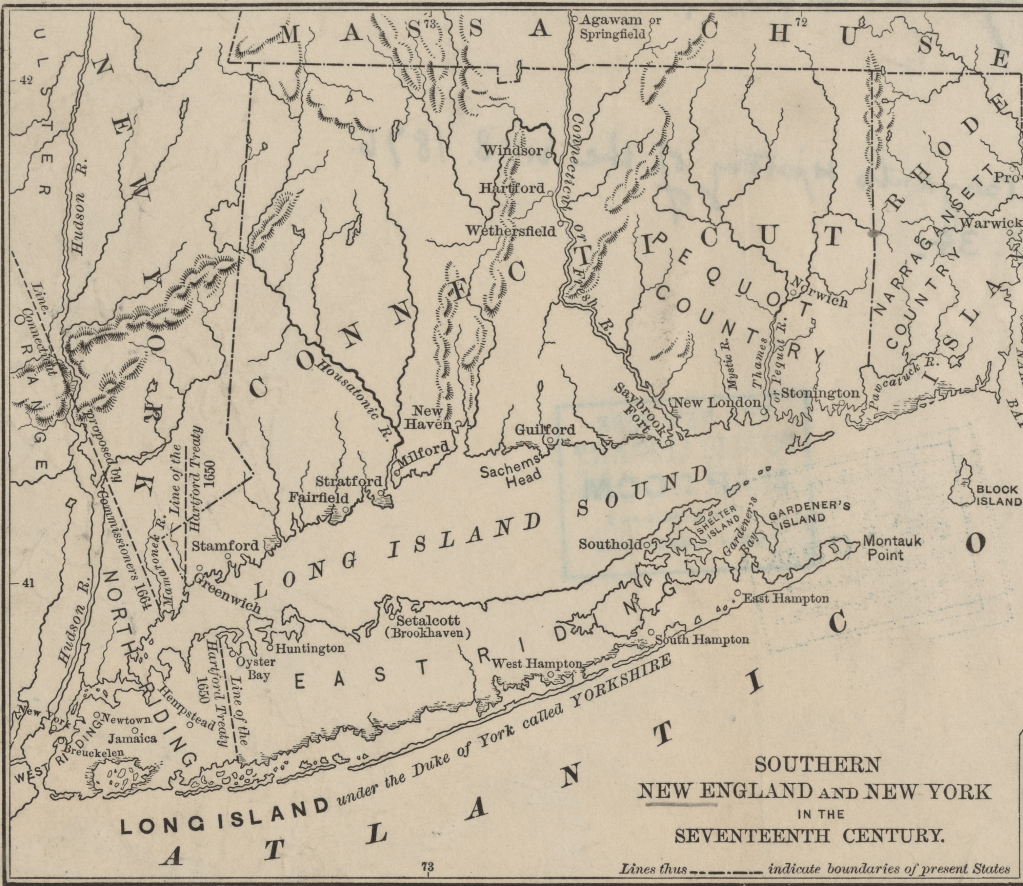
Even after the English defeated the Dutch, controversy continued, as boundaries in the charter of the colony of Connecticut by King Charles II in 1662 and letters patent granted to the Duke of York and Albany in 1664 overlapped. The charter placed Connecticut’s boundaries “on the south by the sea” and from the Massachusetts line “to the south sea on the west part,” while the letters patent placed New York’s boundaries as extending from the Connecticut River. In 1683, New York and Connecticut officials agreed on a boundary running 20 miles east of the Hudson River, except for Connecticut’s retention of its towns east of the Byram River (i.e., Greenwich and Stamford), which lay within that 20 miles. In return, Connecticut would give up its claim to Rye and cede an equivalent tract of land north of the “panhandle.” Called “The Oblong,” this tract, 1.81 miles wide, extended north to Massachusetts from what became Ridgefield. But once again, the agreement was not ratified. It was not until 1731 that commissioners from both colonies performed a complete survey and placed monuments to mark the boundary.
The entire length of The Oblong can be seen on this 1780 map of “Connecticut and parts adjacent”:
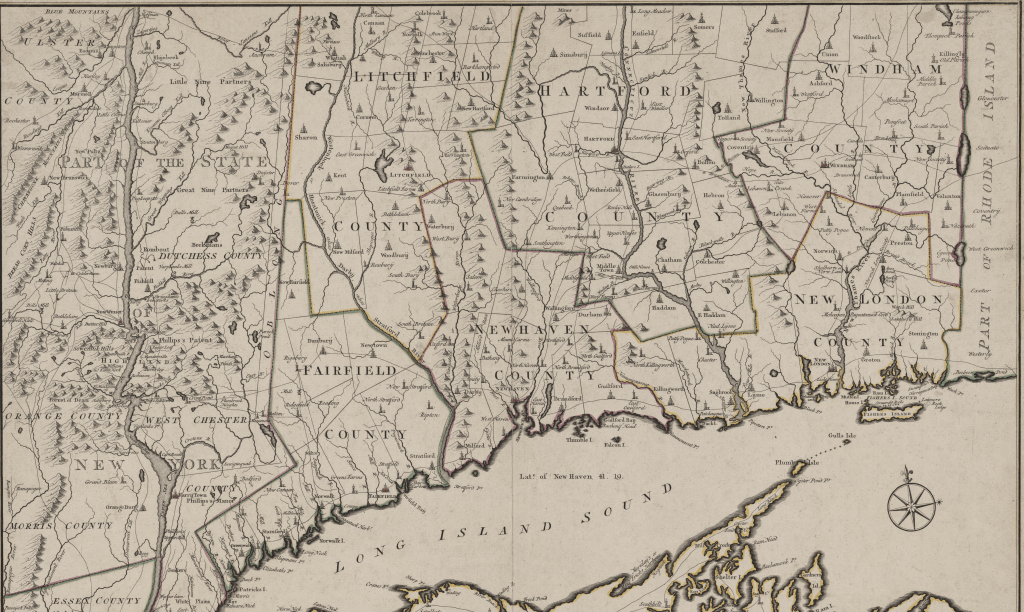
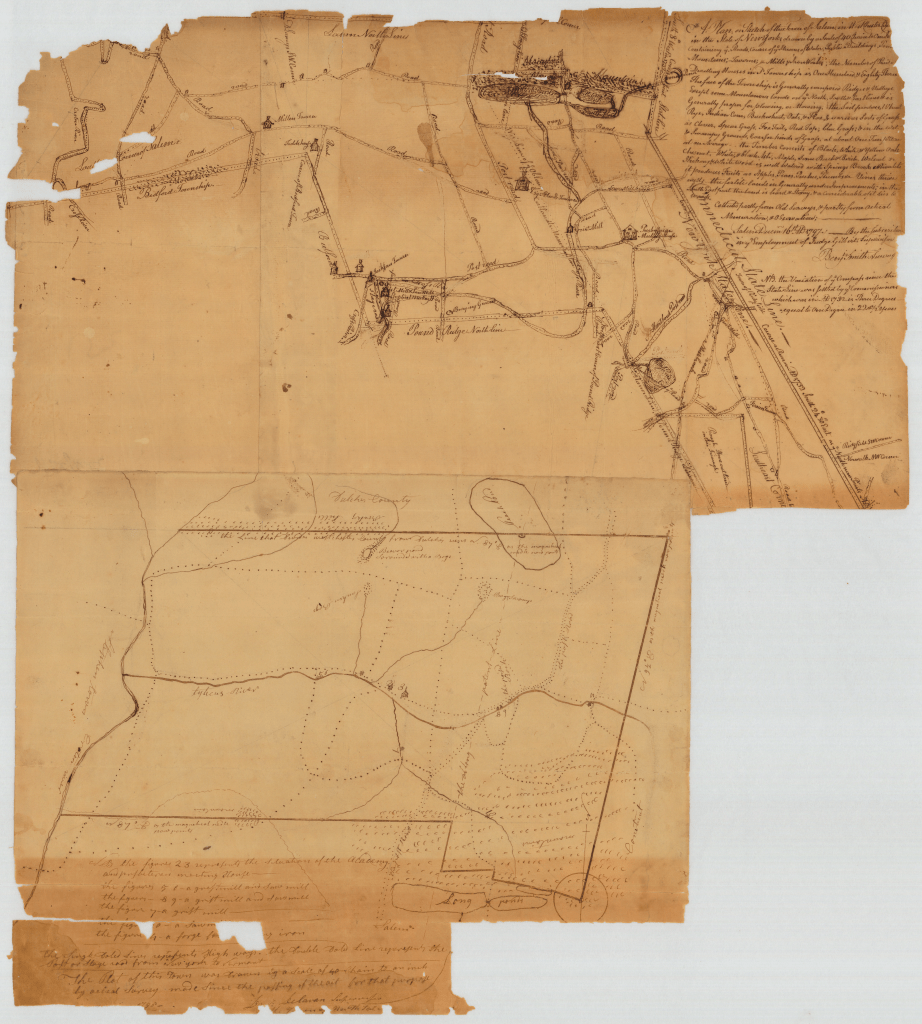
A close-up look at Fairfield County on the map shows the Town of Salem, just west of Ridgefield, lying within The Oblong:
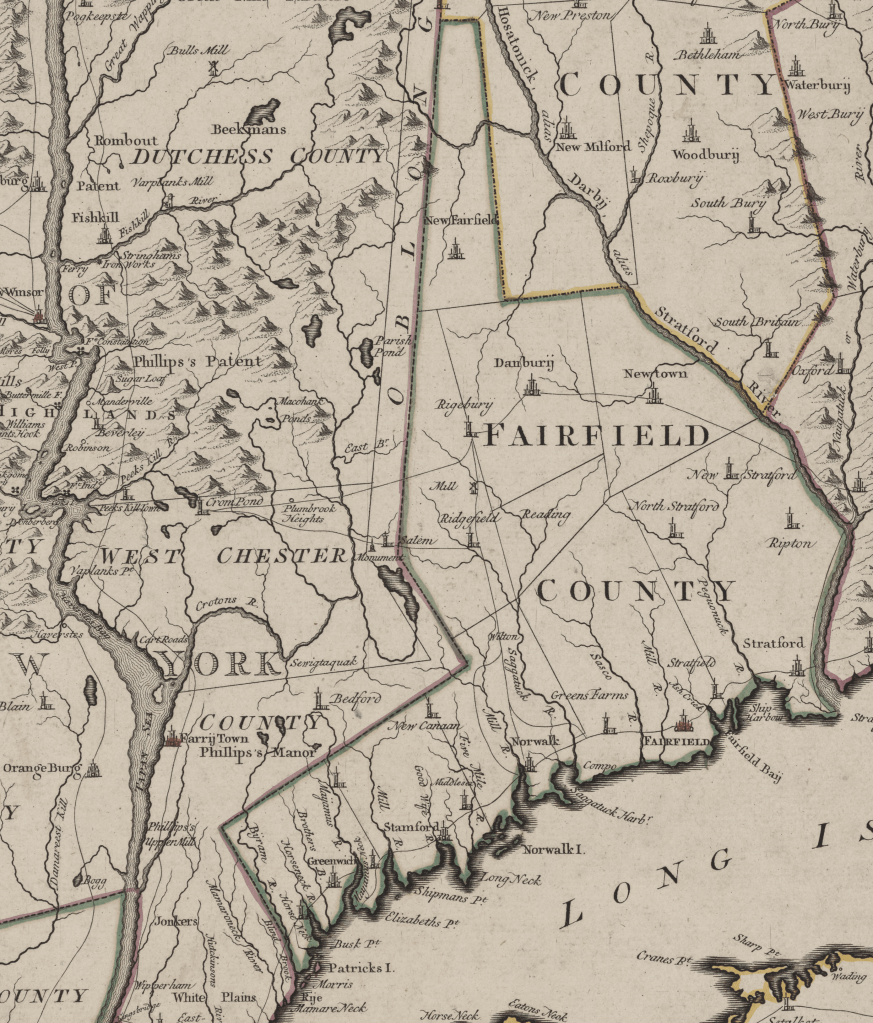
Salem became Upper Salem and Lower Salem in 1784, and in 1788, Upper Salem was incorporated into the Town of North Salem, along with the eastern portion of Cortlandt Manor that had been in the hands of Stephen Delancey prior to its confiscation given that Delancey took the loyalist side in the Revolutionary War.
John Wallis/Wallace lived a long life: he was buried in June Cemetery in North Salem; according to the entry on Find a Grave, the gravestone reads, “In memory of John Wallace who died March 2, 1812 in the 103rd year of his life.”
Even though over the course of his life John Wallis moved no more than a half dozen or so miles from where he was born, over the course of that century, the lives of all who lived in this little corner of America were shaped by numerous contested and changing boundaries — concerning not only the erasure of Indigenous ownership and negotiation of limits of neighbouring colonial towns and colonies, but the boundaries of national identities, racial differences, and people’s status as free, indentured, or enslaved.
Much more remains to be said about what became of Sarah Burt; Sarah Burt’s child, who was without name and even sex in the court records; Peter, who was enslaved in the Burt household; and the rest of the Burt family. And much more again remains to be said about the wresting of land from its Indigenous owners, the history of slavery in Connecticut, the dynamics of the construction of racial difference in 18th-century New England, and how race and slavery shaped social and economic relations among Ridgefield families, which having been transmitted across generations exercise their legacies today. These are topics of future posts.
Footnotes
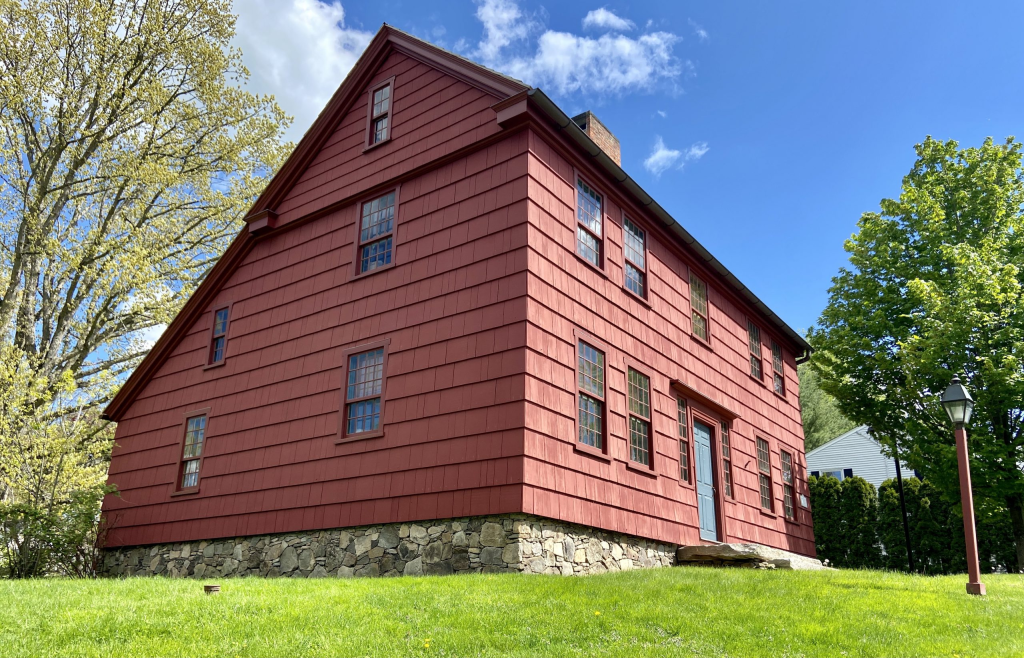
- Thomas Hyatt’s Norwalk house, built in 1677 and one of only a few houses left standing after the British burned Norwalk in the Revolutionary War, was illegally demolished in 2022. Comments on the article reflect divergent ideas about preservation and relations to the past. ↩︎
- Eunice (last name unknown) was Joshua Lobdell’s second wife. Mary Burwell, of Milford, was his first wife and mother to Susannah Lobdell, who married Sarah’s brother Seaborn Burt. ↩︎
- Among the original Ridgefield proprietors, there were two Samuel Smiths. In land records, to distinguish them, the Samuel Smith from Norwalk is referred to as “Norwalk Samuel Smith” and the Samuel Smith from Milford is referred to as “Milford Samuel Smith.” ↩︎
References
Books and articles:
Cohn, Henry S. 1970. “Connecticut’s Divorce Mechanism: 1636-1969. American Journal of Legal History 14 (1): 35–54; https://doi.org/10.2307/844518.
Jacobus, Donald Lines. 1968. “The Scott Family of Ridgefield, Conn.” The American Genealogist 44 (1): 9–14.
Rockwell, George L. 1927. The History of Ridgefield, Connecticut; https://archive.org/details/TheHistoryOfRidgefieldConnecticut/
Sanders, Jack. “A Stroll Through Time.” 068 Magazine (March/April 2022): 14-18; https://issuu.com/ridgefieldmagazine/docs/completemarch_april2022
Archival materials:
Divorce Papers, 1720-1799 (Fairfield Superior Court) – Connecticut State Archives / Genealogical Society of Utah — available on FamilySearch
Connecticut Archives Series, Crimes & Misdemeanors,
First Series, Vol. 2 (available on FamilySearch) & Vol. 4 (available on FamilySearch)
Land Records, Ridgefield Town Clerk (available on Family Search)
Acknowledgements
Thanks to Susan Bigelow, librarian at the Connecticut State Library, for help locating sources.
Thanks to the Dartmouth Family History Centre, and help from Ann Smith, for access to historical and archival records reproduced by the Latter Day Saints.
Thanks to historian Jack Sanders for sharing his work and providing feedback and advice based on his extensive knowledge of Ridgefield, past and present. Jack’s books can be found here.
Copyright, December 2024, by Lisa Gannett — no reproduction or commercial use without permission of author










 Lisa Gannett